
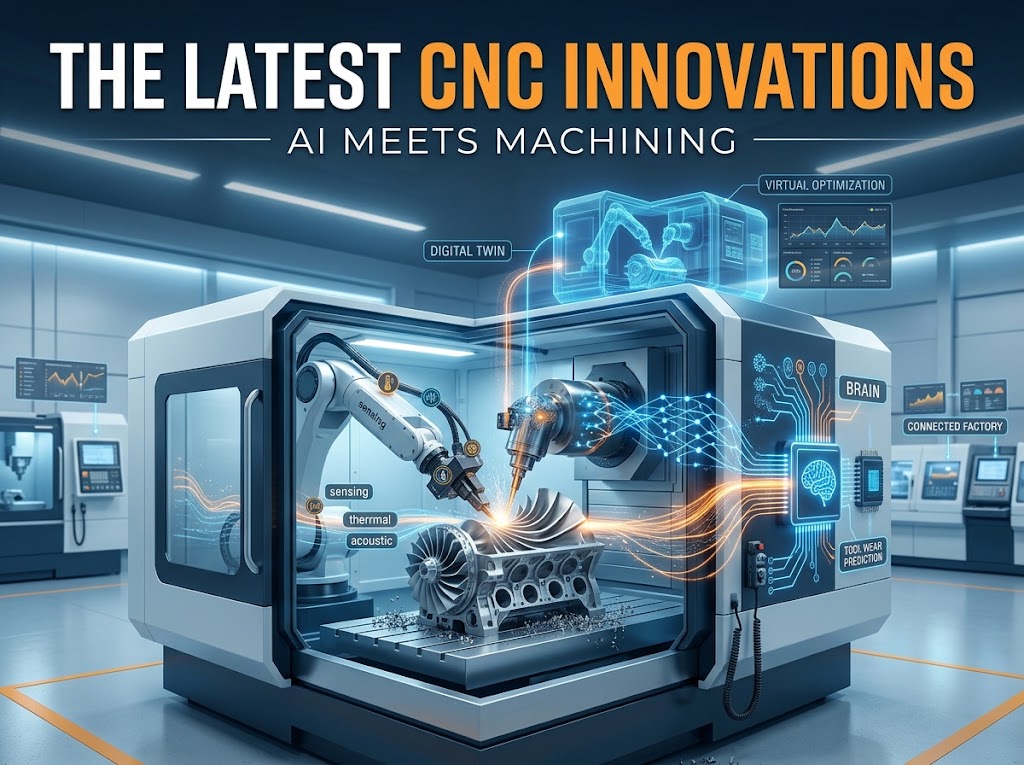
The Latest CNC Innovations: AI Meets Machining
The CNC machine is one of the most dependable workhorses in manufacturing. For over sixty years, computer numerical control machines have been cutting, milling, turning, and drilling metal with a precision that human hands could never match. And for most of that history, a CNC machine was a pretty dumb device: it followed a program, step by step, blind to what was actually happening at the cutting edge.
That era is ending. The latest CNC innovations are making machines that can see, sense, learn, and adapt. Artificial intelligence is moving from the cloud into the machine controller, sensors are giving machines a sense of touch, and the dream of fully autonomous machining is getting closer. If you think CNC machining has reached its limit, think again. The newest chapter is just beginning.
From G-Code to Self-Improving Machines
To appreciate what is new, it helps to understand the old way. A traditional CNC machine reads a program written in G-code, a language of coordinates and commands that tells the machine where to move and how fast. The program is prepared in CAM software, based on the part geometry and the machinist’s knowledge of materials and tools.
The machine executes the program exactly as written, every time. If the tool wears out, the material is harder than expected, or the machine heats up, the machine does not know. It just keeps cutting, and the result might be a scrapped part.
The latest CNC innovations are changing this relationship. Instead of a one-way flow from program to machine, the new generation creates a feedback loop: the machine senses what is happening, compares it to what should be happening, and adjusts on the fly. This is the difference between playing a song from sheet music and improvising with a live band.
AI in CNC Machining: The Brain Enters the Machine
Artificial intelligence is the headline technology in modern CNC. AI algorithms analyze the data streaming from machine sensors, vibration, spindle load, temperature, acoustic emissions, and tool position, and they learn the signatures of a healthy cut.
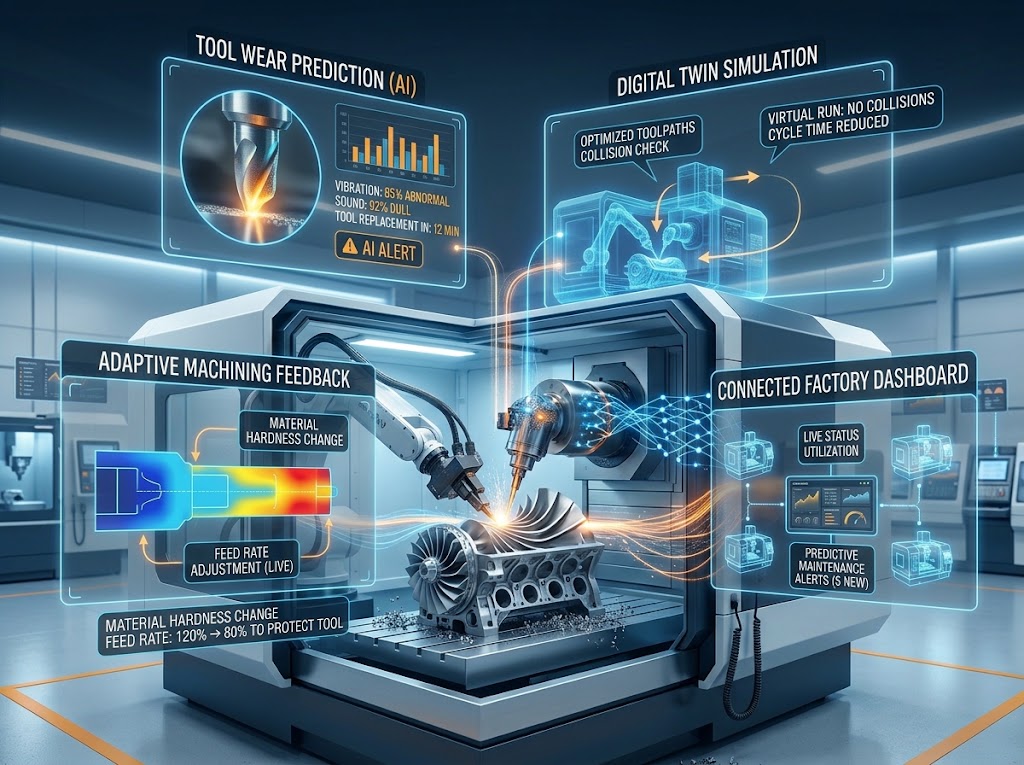
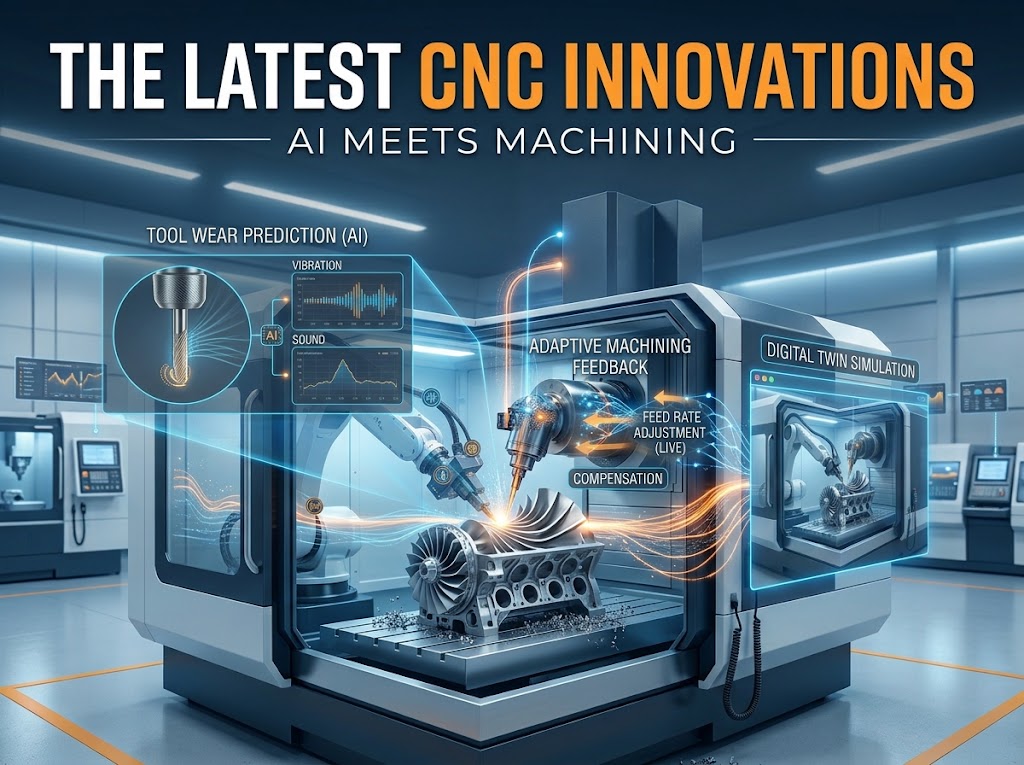
The first practical application is tool wear prediction. A cutting tool dulls over time, and a dull tool produces poor surface finish, dimensional drift, and eventually, breakage. AI models can detect the subtle changes in vibration and sound that precede tool failure, and they alert the operator or adjust the machining parameters automatically. Some systems predict remaining tool life to the minute, allowing tools to be replaced just before they fail, maximizing tool life and eliminating surprise breakages.
AI is also being used for adaptive machining. If the machine senses that the material is harder in one area, it can reduce the feed rate to protect the tool. If a part is running slightly undersized, the machine can compensate in the next pass. This closed-loop control is the essence of smart machining, and it dramatically reduces scrap and rework.
Another frontier is process optimization. AI systems can simulate thousands of machining strategies and find the one that balances speed, tool life, and surface quality. They learn from every part ever made on the machine, continuously improving the recommendations. A machine that has been running for a year knows more about its own capabilities than any machinist could memorize.
The Rise of the Digital Twin in Machining
Digital twins, virtual replicas of physical machines, are becoming a standard tool in CNC machining. A digital twin of a machine tool simulates the entire machining process, including the spindle, axes, tool, and even the thermal behavior of the machine structure.
The digital twin lets engineers simulate a new part program before it ever touches a real machine. They can check for collisions, optimize toolpaths, and predict cycle times without tying up the production machine. They can also detect problems: if the twin shows that a tool will chatter on a certain feature, they can adjust the strategy in the virtual world, where mistakes are free.
In advanced implementations, the digital twin runs in parallel with the real machine, updated with live data. This “digital shadow” gives operators a real-time view of what is happening inside the machine, even if it is an enclosed, unobservable machining center. When a problem occurs, the twin helps diagnose it by replaying the sequence of events.
Sensors, Connectivity, and the Connected Factory
Modern CNC machines are covered in sensors and connected to the industrial internet of things. Vibration sensors on the spindle, thermal sensors on the structure, acoustic sensors listening to the cut, load sensors on the axes: each one streams data continuously.
This connectivity creates the connected factory, where every machine reports its status, utilization, and health in real time. Production managers see live dashboards of machine availability, job progress, and alerts. Maintenance teams receive predictive warnings instead of emergency calls. The machine data also feeds enterprise systems, improving scheduling, costing, and quality tracking.
Connectivity is not just about monitoring. Remote diagnostics allow experts to troubleshoot machines from anywhere in the world. Software updates are delivered over the network, adding new capabilities to installed machines. Some manufacturers now sell machines with “uptime guarantees” backed by continuous monitoring and predictive service.
Hybrid Manufacturing: Machining Meets 3D Printing
One of the most exciting latest CNC innovations is hybrid manufacturing, which combines additive and subtractive processes in a single machine. A hybrid machine can 3D print metal to build up material, then machine it to final shape, switching between processes automatically.
This combination is powerful. Additive manufacturing can create complex internal geometry, repair worn parts by building up material, and add features to existing components. Machining provides the precision, surface finish, and dimensional accuracy that printing alone cannot achieve. Together, they enable parts and repair strategies that were impossible before.
Hybrid machines are used in aerospace repair, where turbine blades and other expensive components are refurbished instead of replaced. They are used in tooling, printing complex mold inserts and machining them to finished quality. And they are used in prototyping, where a part can be printed and finished in a single setup, without moving between machines.
Automation Beyond the Machine
The latest CNC innovations extend beyond the machine tool itself. Automation is wrapping the machine in a system of robots, pallets, and software.
Machine tending robots load and unload parts, so machines run unattended through the night. Pallet systems automatically swap workpieces, allowing a machine to process a queue of different parts. In-process inspection systems measure parts on the machine and feed corrections back automatically. Some factories run “lights-out” machining, where the machines produce parts all night with no human presence, and the results are waiting in the morning.
This automation is becoming accessible to smaller shops. The same technologies that once required a million-dollar installation are now available as modular, affordable systems. A single machine with a robot and a pallet system can operate like a miniature automated factory.
The Human Side of Smart Machining
With all this technology, what happens to the machinist? The role is changing, but it is not disappearing. The machinist is becoming a supervisor, data analyst, and problem solver.
The new machinist sets up jobs, monitors dashboards, handles exceptions, and makes judgment calls that software cannot. They interpret the AI’s recommendations, decide when to intervene, and continuously improve the process. The skill set is shifting from manual dexterity to data literacy and systems thinking, and skilled machinists are more valuable than ever.
Companies are investing in training, because the technology is only as good as the people who use it. The best results come from combining human judgment with machine intelligence: the machinist brings experience and creativity, and the AI brings tireless monitoring and pattern recognition.
The Road Ahead
The latest CNC innovations point toward a future where machines are not just precise, but intelligent. They will continue to learn from every part they make, anticipate their own maintenance needs, communicate with the rest of the factory, and adapt to changing conditions without human intervention.
The challenges are real: the cost of new technology, the complexity of integrating it with existing equipment, cybersecurity concerns, and the need for new skills. But the trajectory is clear. AI in CNC machining is not a gimmick; it is the natural evolution of a technology that has been improving for sixty years.
The CNC machine that once followed a blind program is becoming a thinking partner. It watches, learns, and improves, and it is making manufacturing faster, more flexible, and more reliable than ever. The future of machining is not just automated; it is intelligent, and it is arriving right now.