3D Printing for Mass Production: How Long Until It Arrives?
For decades, 3D printing was the technology of “one”: one prototype, one custom part, one beautiful demonstration. Even as additive manufacturing matured, the question that haunted it was always the same: can it produce millions of parts, cheaply and reliably, like injection molding or stamping? Can 3D printing mass production ever actually happen?
The answer, as of the mid-2020s, is that it is happening, faster than most people realize. Additive manufacturing has crossed from prototyping into real production for specific products, and the industry is scaling aggressively. The question is no longer whether 3D printing will be used for mass production, but which products, when, and at what scale. Let’s look at where the technology stands, what is driving the shift, and how long it will take to transform manufacturing.
Why Mass Production Was the Impossible Dream
To understand the transformation, start with why additive manufacturing seemed unsuited for mass production for so long.
The fundamental problem was speed. Injection molding can produce thousands of parts per hour; the fastest 3D printers historically produced a handful. When you need a million identical parts, the cost per part of 3D printing was simply too high.
Consistency was the second problem. 3D printed parts varied more than molded parts, in dimensions, in mechanical properties, and in surface finish. For safety-critical or tightly toleranced applications, that variability was disqualifying.
Cost was the third. Machines were expensive, materials cost more per kilogram than conventional plastics or metals, and post-processing added labor. The economics only worked for low volumes, high value, or impossible geometry.
These limitations were real, but they were limitations of a young technology, not permanent truths. All three are being attacked simultaneously, and the progress is dramatic.
The Speed Revolution
The most visible change is speed. The additive manufacturing industry has been obsessed with throughput, and the results are impressive.
Multi-laser systems are the leading edge. Metal printers that once used a single laser now use four, eight, or even dozens of lasers, working in parallel across the build area. Print times that took days are now measured in hours. Large-format systems expand the build volume, so more parts are produced per run.
Continuous printing is another breakthrough. Instead of the stop-start motion of traditional printers, new systems use continuous processes, with materials fed and cured or fused in a steady stream. High-speed sintering and similar technologies print polymer parts at rates approaching injection molding for some geometries.
The compounding effect is enormous. When a printer gets ten times faster, and the build volume doubles, and multiple printers run in parallel, the economics shift by orders of magnitude. The speed revolution is what makes the mass production question worth asking.
The Economics Are Crossing the Threshold
The economics of additive manufacturing are improving along multiple curves, and for specific products, they have already crossed the threshold where 3D printing is cheaper than conventional manufacturing.
The first economic advantage is tooling elimination. Injection molding requires expensive molds; die casting requires dies; stamping requires tooling. 3D printing requires none of it. For a product that will be iterated, customized, or produced in uncertain volumes, eliminating tooling is a huge win.
The second advantage is material efficiency. Machining carves away up to 90 percent of the raw material; additive manufacturing uses almost all of it. For expensive materials like titanium, this advantage is decisive.
The third advantage is consolidation. A product that required twenty parts, and twenty assembly steps, can be printed as one part. The savings in assembly labor, inventory, and quality control often outweigh the higher per-part cost of printing.
The fourth advantage is the elimination of inventory. Instead of manufacturing a product in batches and storing it, companies print on demand. Digital inventory replaces physical inventory, eliminating warehousing costs and obsolescence risk.
When these advantages align, additive manufacturing wins even at conventional production volumes. The number of products where it wins is growing every year.
Who Is Already Doing Mass Production?
The proof that 3D printing mass production is real is in the products already being made.
The most famous example is dental aligners. Companies like Invisalign produce millions of custom aligners using additive manufacturing, and the process is so deeply integrated that the product would not exist without it. Each aligner is customized, which is exactly where 3D printing excels.
Hearing aids are another billion-dollar success. Over 99 percent of custom hearing aids are now 3D printed, replacing labor-intensive manual processes. The shells are printed from digital scans, with better fit, faster delivery, and lower cost.
Footwear is scaling rapidly. Major brands are 3D printing midsoles and insoles, producing hundreds of thousands of customized parts. The sneaker industry is betting big on additive manufacturing as the path to mass customization.
Aerospace is producing certified end-use parts in volume. GE Aerospace has produced hundreds of thousands of 3D printed fuel nozzles and other components. The aviation industry is using additive manufacturing for both serial production and spare parts, with digital warehouses replacing physical stockpiles.
Even automotive is moving. Car manufacturers are printing prototypes, tooling, and low-volume parts, and some are exploring printed structural components for volume models. The transition is slower than in medical and aerospace, but it is happening.
The Role of AI and Data
The next chapter of additive manufacturing mass production will be driven by intelligence as much as hardware.
AI is being used to design parts for printability and performance. Generative design creates geometries that exploit additive manufacturing’s design freedom, and AI validates them before a single layer is printed.
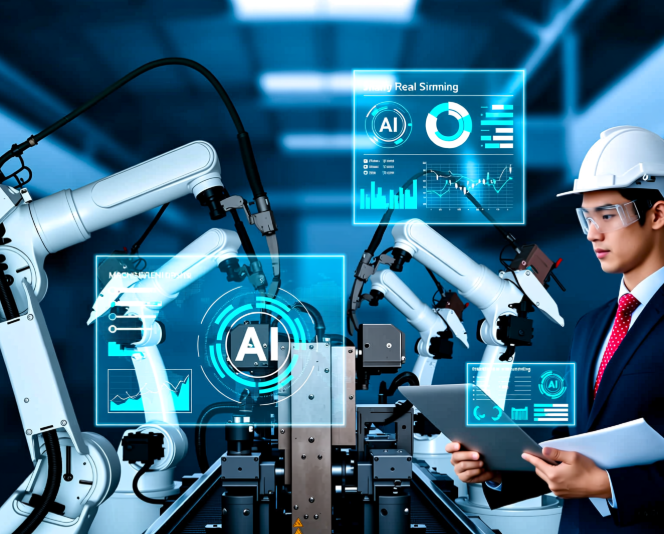
AI is also transforming quality control. In-process monitoring systems watch every layer with cameras, thermal sensors, and acoustic sensors. Machine learning models detect defects as they form, allowing correction or rejection in real time. This is the key to the consistency that mass production demands.
The data from every print feeds the models, making the next print better. Over time, the process becomes self-improving, with yields climbing and costs falling. The combination of additive hardware with AI software is the technology’s most exciting frontier.
The Barriers That Remain
For all the progress, real barriers remain before additive manufacturing reaches true mass production.
Speed is still the biggest barrier for simple, high-volume parts. For a plastic bottle cap or a simple bracket, injection molding will remain cheaper for years. Additive manufacturing wins where complexity, customization, or consolidation creates value, not where the part is trivially simple.
Materials are the second barrier. The additive material library is growing, but it is still far smaller than the universe of conventional materials. Properties, certification, and consistency vary more than for molded or forged parts.
Cost per part remains higher for many applications. The gap is closing, but for price-sensitive consumer products, the economics still favor conventional processes.
And there is the ecosystem challenge: supply chains, standards, and skills. Mass production requires repeatable processes, certified materials, and trained operators. The industry is building these, but they take time.
The Roadmap: How Long Until It Arrives?
Forecasting the additive manufacturing timeline requires distinguishing between what is happening, what is scaling, and what is still emerging.
Today, additive manufacturing is already the standard for products that are customized, complex, or expensive: medical implants, dental aligners, hearing aids, aerospace components, and high-performance tooling. This is mass production in the sense of millions of units, just not for commodity parts.
By 2030, expect additive manufacturing to be routine in footwear, consumer goods, and automotive spare parts, with production volumes in the hundreds of millions. High-speed polymer systems and metal printing farms will be common. Digital inventories will be standard practice for spare parts across industries.
Beyond 2030, the technology will keep pushing into higher-volume territory. The industry forecasts suggest additive manufacturing’s share of global manufacturing will grow from a tiny fraction today to a meaningful slice over the next two decades, driven by continued improvements in speed, materials, and cost.
The Bottom Line
The question “how long until 3D printing mass production arrives?” has a nuanced answer: it has already arrived, for the products where additive manufacturing creates the most value, and it is arriving everywhere else, one year at a time.
The additive manufacturing scaling story is not about replacing injection molding in the next five years. It is about expanding the territory where digital, layer-by-layer production wins: customized products, complex geometry, consolidated assemblies, and on-demand supply. Each year, that territory grows.
The future of manufacturing is not a choice between additive and conventional; it is a portfolio where each process does what it does best. 3D printing will never stamp out a billion bottle caps, but it will produce a billion personalized insoles, a million bespoke implants, and a hundred thousand optimized aircraft brackets. That is mass production, and it is not a distant dream. It is happening right now, and the pace is only accelerating.