Why Does My Car Shake? Common Causes and How to Fix Them
You’re cruising down the highway, everything feels smooth, and then it starts: a subtle vibration in the steering wheel that grows into a full-body shimmy. Or maybe your car shakes when you hit the brakes. Or perhaps it only shakes when you’re sitting at a red light. Car shaking is one of the most common — and most confusing — complaints in the automotive world, because it can be caused by a dozen different things. The good news? Most of them are cheap and easy to fix. Let’s play detective and track down what’s making your car dance.
When does your car shake? That's the first clue
Before anything else, notice when the shaking happens. Is it at highway speed? Only when braking? At idle? When turning? The timing is your biggest clue, because different causes show up at different times. So grab your mental notebook and match your symptom to the suspects below.
Shakes at highway speed → wheel balance
If your car vibrates when you reach about 50–60 mph (80–100 km/h) and it smooths out at lower speeds, the most likely culprit is an out-of-balance wheel. Every wheel-and-tire assembly should spin evenly, but a missing balance weight, a shifted tire, or a slightly bent wheel can make it wobble like a washing machine on spin cycle.
The fix is a wheel balance (often called tire balance): a technician mounts the wheel on a balancing machine, finds the heavy spot, and adds small weights to even it out. It’s quick, affordable, and usually cures highway-speed vibration instantly. If balancing doesn’t help, the tire or wheel itself may be damaged and need replacement.
Shakes when braking → warped brake rotors
Does the steering wheel or brake pedal pulse and shudder every time you brake from speed? That’s the classic signature of warped or unevenly worn brake rotors. When your brake pads squeeze against a rotor that has high and low spots (from heat stress or uneven wear), the contact becomes grabby instead of smooth, sending a pulsing vibration through the pedal and steering wheel.
The fix depends on severity: rotors can sometimes be machined (resurfaced) to restore a flat surface, but many modern rotors are thin and simply replaced. New pads usually go in at the same time. Rotor problems are often caused by hard braking, towing, or riding the brakes down long hills — heat is the enemy.
Shakes in the steering wheel at speed → wheel alignment and suspension
If the vibration is mostly in the steering wheel, and it’s accompanied by the car pulling to one side or tires wearing unevenly, think wheel alignment. Misaligned wheels create odd tire wear patterns and uneven contact with the road, which translates into steering wheel shake. An alignment service sets the front (and sometimes rear) wheels to the manufacturer’s specs.
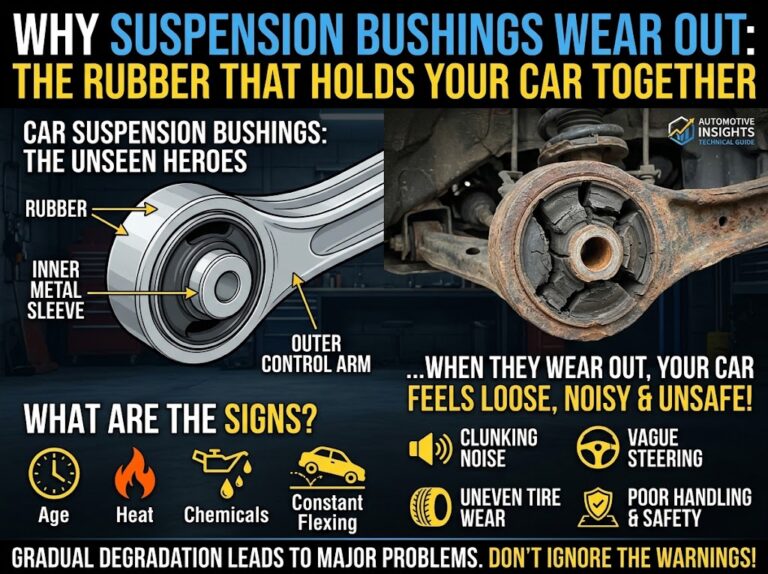
While you’re under there, worn suspension parts are another classic cause of highway shaking. Tie rods, ball joints, control arm bushings, and sway bar links all wear out over time. A loose or worn suspension component lets the wheel move slightly, causing wobble that worsens with speed. A mechanic will inspect the suspension, replace worn parts, and usually recommend an alignment afterward.
Shakes at idle or in park → engine mounts and misfires
Does the whole car vibrate when you’re stopped at a light, but smooth out when you accelerate? That’s the signature of worn engine mounts or an engine running rough at idle.
Engine mounts are rubber-and-metal brackets that hold the engine to the frame and absorb its vibrations. Over years of heat and flexing, the rubber cracks and hardens, letting the engine’s natural vibration pass straight into the cabin. Worn motor mounts often cause a noticeable shake at idle that disappears once the engine spins faster.
Another idle-shake suspect is a misfire — when one cylinder fails to fire properly, the engine runs unevenly and feels like it’s shuddering. Misfires can come from worn spark plugs, faulty ignition coils, clogged fuel injectors, or vacuum leaks. If the “check engine” light is on, the diagnostic trouble codes will point you to the problem cylinder.
Shakes when accelerating → CV joints and driveshafts
If the vibration kicks in when you press the gas and fades when you coast, the problem is likely in the drivetrain — the parts that send power from the engine to the wheels. On front-wheel-drive cars, worn CV joints (the flexible joints at the ends of the drive axles) cause a clicking or shuddering during acceleration, especially when turning. On rear-wheel-drive and 4WD vehicles, an unbalanced or worn driveshaft can vibrate at certain speeds.
CV boots — the rubber covers protecting the joints — are worth checking regularly. If a boot splits and grease leaks out, dirt gets in and the joint wears out fast. Catching a torn boot early means a cheap boot replacement; ignoring it leads to a costly axle replacement.
Other sneaky causes
A few more suspects worth mentioning:
Tire pressure. An underinflated or overinflated tire can cause vibration and a rough ride. Check pressures regularly — it’s free and takes two minutes.
Flat-spotted tires. If a car sits parked for weeks, tires can develop temporary flat spots that cause a thumping vibration until they warm up and round out.
Wheels out of round or bent. Hitting a pothole hard can bend a steel wheel or even damage an alloy wheel, causing vibration that balancing can’t fix.
Sticky brake calipers. A caliper that doesn’t release properly drags the brake, heating the rotor and causing vibration plus poor fuel economy.
Brake dust and debris. Occasionally, a pebble or rust chunk stuck between the rotor and shield can cause a scraping, vibrating feel.
Seasonal and weather-related shaking
Some vibrations are only around for part of the year. In winter, snow packed inside a wheel can throw off the balance dramatically — the classic “thumping at highway speed after a snowstorm” symptom. Washing the wheels or parking somewhere warm usually cures it. Cold temperatures can also stiffen tires, making the ride feel harsher and magnifying small imbalances that were invisible in summer.
In summer, heat is the enemy: hot asphalt, long highway drives, and heavy braking can warp rotors or flat-spot soft tires, especially if the car sits for a while after a hard drive. And if your car vibrates only when the air conditioning is on, that’s usually not a balance problem at all — it’s the engine straining to power the compressor, often felt through worn engine mounts.
How to diagnose it like a pro
You don’t need a fancy shop to start diagnosing. Follow this quick checklist:
1. Note exactly when the shake happens: idle, low speed, highway, braking, or accelerating.
2. Check tire pressure and look for visible damage, uneven wear, or bulges.
3. If it’s at highway speed, get the wheels balanced first — it’s the cheapest fix and the most common cause.
4. If it’s when braking, suspect rotors; have them inspected or resurfaced.
5. If it’s at idle, check engine mounts and engine health (spark plugs, coils, codes).
6. If none of the above fits, have a mechanic check suspension, alignment, and drivetrain components.
The cost of repairs varies widely: a wheel balance is usually under $50–100, new rotors and pads maybe $200–500, engine mounts $200–600, and drivetrain work more. The key is not to ignore the shake — small problems become big (and expensive) ones if left alone. A good rule of thumb: if a vibration appears suddenly after hitting a pothole, curb, or debris, inspect the wheels and tires first; if it appears gradually, wear-related parts like mounts, bushings, and rotors are the more likely suspects.
Quick FAQs
Is it safe to drive a shaking car? For short distances, usually yes — but if the shaking is severe, occurs at high speed, or is accompanied by warning lights or unusual noises, play it safe and have it checked promptly. A shaking car can indicate a wheel about to come loose or a brake failure in the making.
Why does my car shake after new tires? It shouldn’t. If it does, the new tires may be out of balance, improperly mounted, or defective. Take it back to the shop.
Can bad alignment cause shaking? Yes, especially at speed or when combined with uneven tire wear. Alignment itself doesn’t usually cause vibration, but the worn tires it creates can.
Why does my steering wheel shake at 60 mph but not 30? Classic wheel balance issue. The vibration frequency from an unbalanced wheel resonates at highway speeds.
The bottom line
A shaking car is your vehicle’s way of telling you something’s off — and nine times out of ten, it’s something simple like an out-of-balance wheel or worn brakes. Pay attention to when the shake happens, check the cheap stuff first, and don’t put off a professional diagnosis. Your car, your wallet, and your passengers will all thank you.