
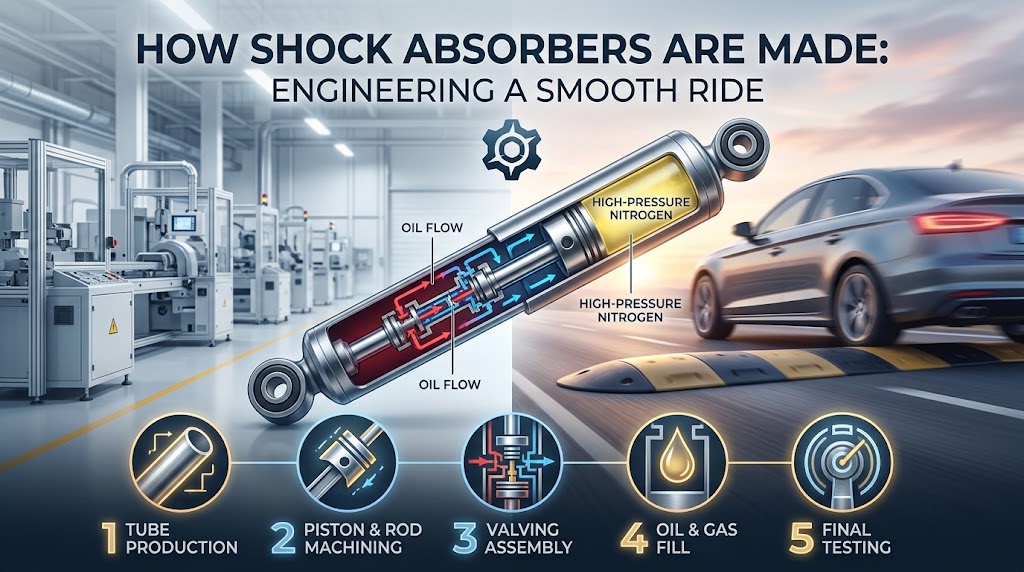
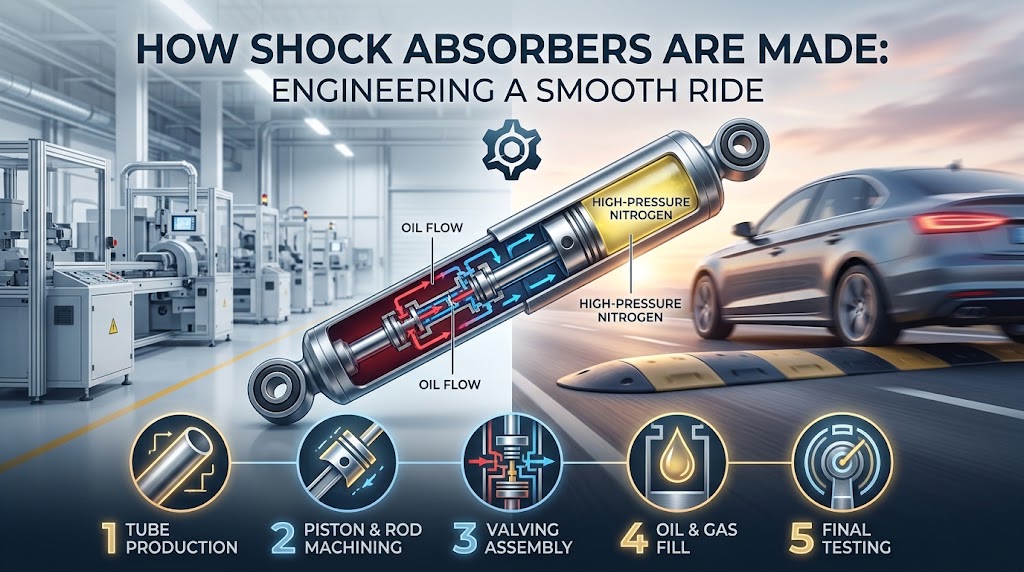
How Shock Absorbers Are Made: Engineering a Smooth Ride
When you drive over a bump, the springs absorb the impact — and then the car would keep bouncing forever if something didn’t stop it. That something is the shock absorber (or damper). It’s a simple idea — a piston moving through oil — wrapped in remarkably precise manufacturing. Making a shock absorber is a story of tight tolerances, high-pressure gas, and metal parts measured in microns. Here’s how the smooth-ride machine gets made.
What does a shock absorber do?
The shock absorber controls the motion of the suspension springs. When a wheel hits a bump, the spring compresses to absorb the energy, then wants to rebound and keep bouncing. The shock slows that motion by converting kinetic energy into heat — the piston pushes oil through small valves, and the resistance of the oil does the damping.
Without shocks, a car would pogo-stick down the road, tires would lose contact, and handling would be dangerous. Shocks keep the tires planted, the body stable, and the ride comfortable. They work constantly: on a rough road, a shock can cycle hundreds of times per minute.
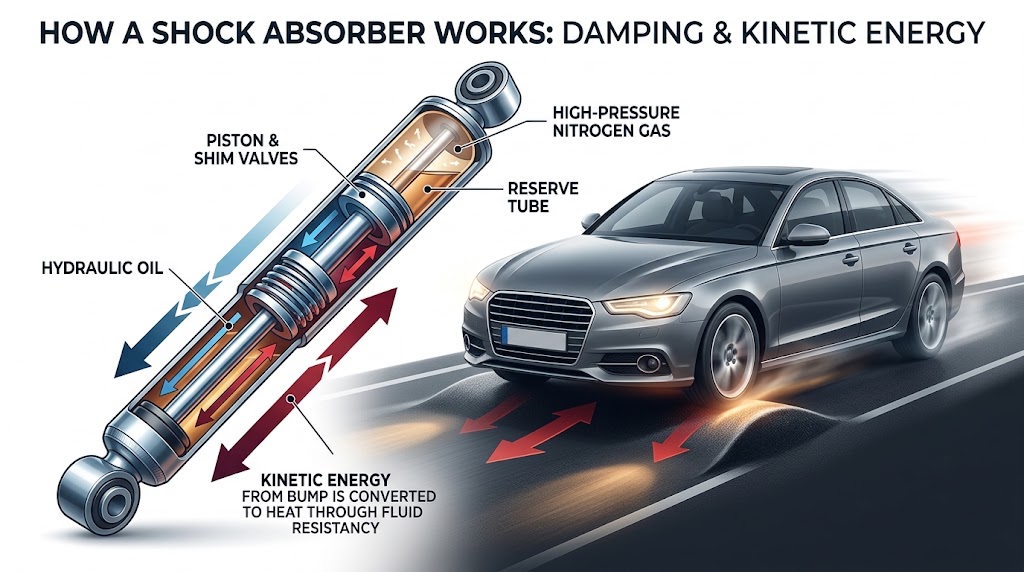
The anatomy of a shock absorber
Every shock absorber has the same core parts:
The outer tube (reserve tube). The main body that holds the oil and protects the internals.
The inner tube (pressure tube). Contains the piston and the oil it pushes through.
The piston and rod. The piston is attached to the rod; the rod connects to the suspension or body. As the suspension moves, the rod pushes the piston through the oil.
Valves. Tiny precision valves in the piston and the base let oil flow at controlled rates — this is what creates the damping force.
The seal and guide. At the top, a seal keeps oil in and dirt out, while a guide keeps the rod moving straight.
Gas charge. Most modern shocks contain nitrogen gas under pressure to prevent the oil from foaming (aeration) during rapid movements.
Step 1: Making the tubes
Shock absorbers start with steel tubing. The outer tube is cut to length from welded steel tube, then cleaned and prepared for welding. The inner pressure tube needs a smooth, precise bore — it’s often drawn or honed to tight tolerances so the piston can slide with the right clearance.
Step 2: Machining the piston and rod
The piston and rod are the heart of the shock, and they’re machined with serious precision:
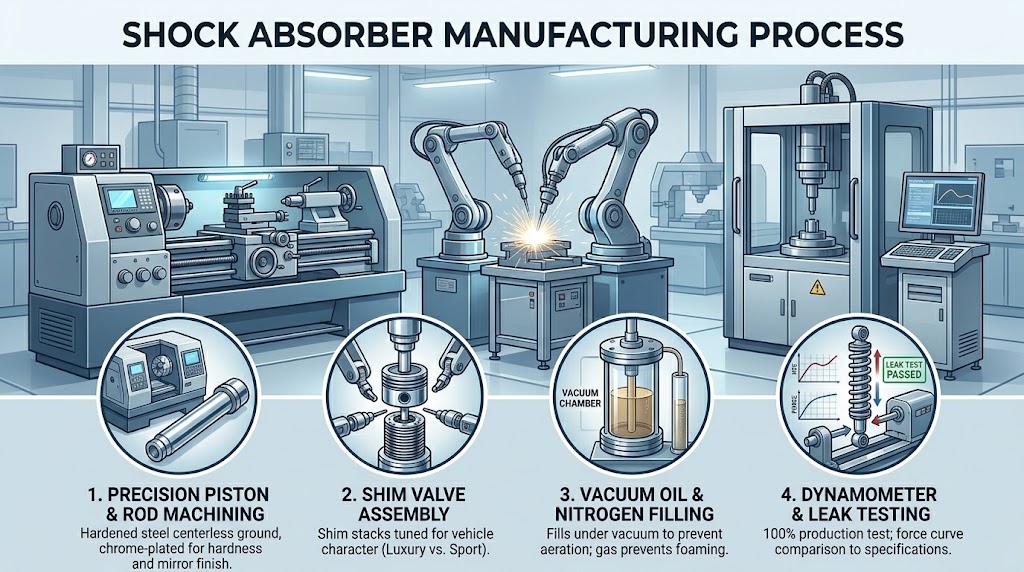
The rod is made from hardened steel, centerless-ground to a mirror finish so the seal doesn’t wear and oil doesn’t leak. Rods are also chrome-plated for hardness and corrosion resistance. The rod’s surface finish matters enormously — a rough rod destroys seals and leaks oil.
The piston is machined with grooves for the valves and rings, then the valve stack (a set of thin steel discs called shims) is assembled onto it. The shims act like one-way doors: they bend to let oil flow in one direction and seal tightly in the other. The number and thickness of shims determine the shock’s damping curve.
Step 3: Assembling the valving
The valving is where the engineering happens. The piston valve stack controls compression damping (when the shock compresses), and a separate base valve controls rebound damping (when it extends). By stacking different shim combinations, engineers tune the shock’s behavior for different vehicles — a luxury car gets soft valving, a sports car gets firm valving.
Each valve disc is a thin piece of spring steel, and they’re stacked like coins, bolted together with a small screw or rivet. The exact stack is often proprietary — it’s the secret sauce of each manufacturer’s ride character.
Step 4: Filling with oil and gas
Now the shock gets its working fluid. The oil is a special hydraulic fluid, chosen for consistent viscosity across temperatures — it has to work at -20°F and 200°F. The tubes are filled under vacuum to remove air bubbles, because air in the oil makes the damping spongy.
After filling, most shocks get a nitrogen gas charge. The gas sits above the oil (in a twin-tube design) or in a separate chamber (in a monotube design), keeping the oil under pressure so it doesn’t foam during rapid piston movement. Gas-charged shocks are standard today because they respond faster and resist fade better than old non-pressurized designs.
Step 5: Sealing and final assembly
The rod seal and guide go in at the top, and the whole unit is crimped or welded closed. The seal is critical: it has to hold high-pressure oil and gas inside while the rod slides through it millions of times. Multi-lip seals with built-in wipers are the standard — the wiper scrapes dirt off the rod as it retracts.
Step 6: Testing
No shock leaves the factory without a test. Each one is run on a dynamometer that cycles it through compression and extension strokes while measuring force. The force curve is compared to the spec — too soft or too hard, and it’s rejected. Some factories test 100 percent of production shocks this way.
Shocks are also leak-tested (dunked in a bath and checked for bubbles) and visually inspected. The tolerances are tight: valve shims measured in hundredths of a millimeter, oil fill volumes measured to the gram.
How damping is tuned: the dyno curve
If you’ve ever wondered how a shock absorber “knows” how much resistance to provide, the answer is in its valving — and the graph that describes it. When engineers develop a shock, they test it on a dynamometer that pushes the piston through different speeds and measures the force it produces. The result is a damping curve: force versus piston speed, with separate traces for compression and rebound.
The shape of that curve is everything. A luxury car’s curve is gentle at low speeds, so small bumps are absorbed softly, but it rises at higher piston speeds to control big impacts. A sports car’s curve is firmer throughout, keeping body motion tight. The tuning comes from the valve shim stacks: thinner shims bend easily and give a soft curve; thicker shims or preload spacers make the curve firmer. A single shim change can transform the ride.
That’s why “sport” and “comfort” shocks for the same car are physically identical — same tubes, same piston — but internally valved completely differently. It’s also why aftermarket shocks claim to be “custom tuned”: the manufacturer is literally selecting the shim stack for a specific character. Understanding this is the difference between treating a shock as a mystery box and seeing it as the precisely tuned instrument it is.
Twin-tube vs. monotube
There are two main shock designs:
Twin-tube shocks have two tubes — the pressure tube inside a reserve tube that holds extra oil and the gas charge. They’re cheaper, more common, and excellent for everyday driving.
Monotube shocks have a single tube with the gas in a separate chamber behind a floating piston. They dissipate heat better and respond faster, making them the choice for performance and heavy-duty applications. They cost more but perform better under stress.
Quality and lifespan
A good shock absorber is designed to last 50,000 to 100,000 miles, which means millions of cycles. The wear parts are the seal (which can leak with age), the rod (which can pit), and the internal valves (which can wear). When shocks wear out, the ride gets bouncy, braking nose-dives, and tires wear unevenly — the classic “time for new shocks” symptoms.
Quick FAQs
What’s the difference between a shock and a strut? A shock is just a damper. A strut is a shock that also serves as a structural suspension link (usually with a spring wrapped around it).
Are gas shocks better than oil-only shocks? Generally yes — the gas charge prevents oil foaming and improves response. That’s why most modern shocks are gas-charged.
Why do shocks fail? Seals wear, oil leaks out, and internal valving fatigues. Heat and road salt accelerate the process.
Can shocks be rebuilt? Some high-end units can be rebuilt by specialists, but most production shocks are sealed units meant to be replaced.
The bottom line
The shock absorber looks like a simple metal cylinder, but it’s actually a precision hydraulic instrument: a mirror-finished rod, a piston with micro-tuned valve stacks, carefully measured oil, and a pressurized gas charge, all sealed in steel. Every one is tested before it leaves the factory. It’s the quiet part that turns a bouncing, skittish car into a composed, comfortable one — and now you know exactly how it’s made.