
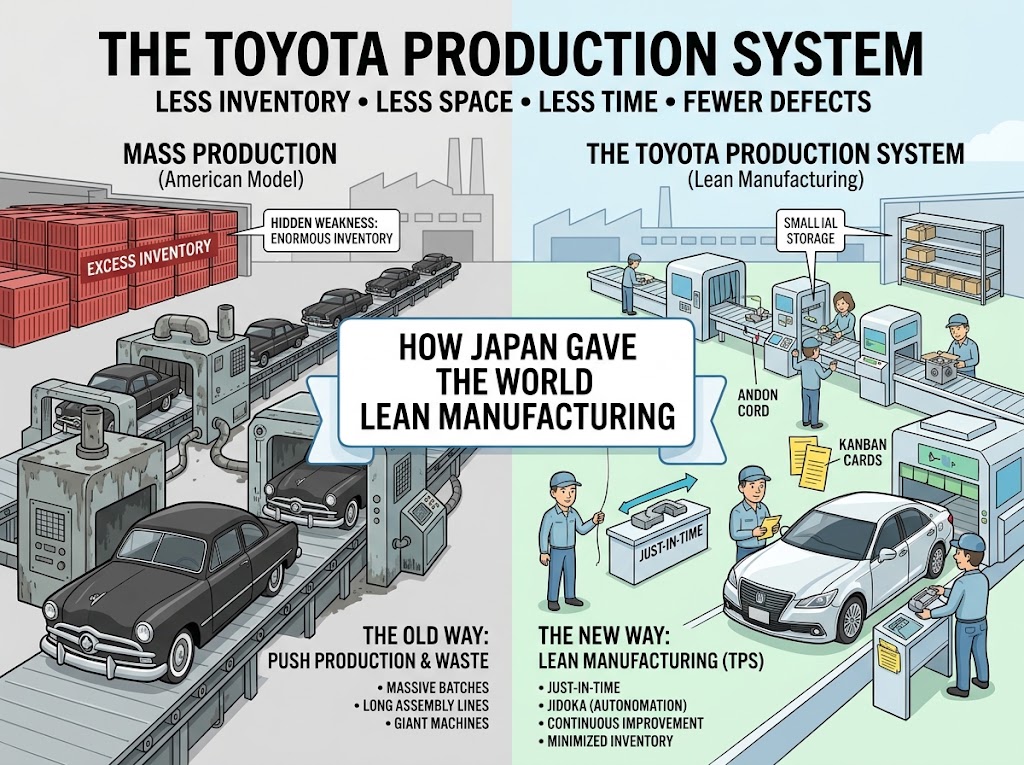
The Toyota Production System: How Japan Gave the World Lean Manufacturing
In 1950, Toyota was a small Japanese carmaker facing a crisis. Its domestic market was tiny, its capital was scarce, and it could never hope to copy the giant American factories of Ford and General Motors. So Toyota did something that would change manufacturing forever: it built a production system that required less of everything. Less inventory, less space, less time, fewer defects. Decades later, Western researchers gave that system a name that stuck: lean manufacturing. The story of the Toyota Production System is not just the story of a car company. It is the origin story of the most influential management philosophy in modern industry.
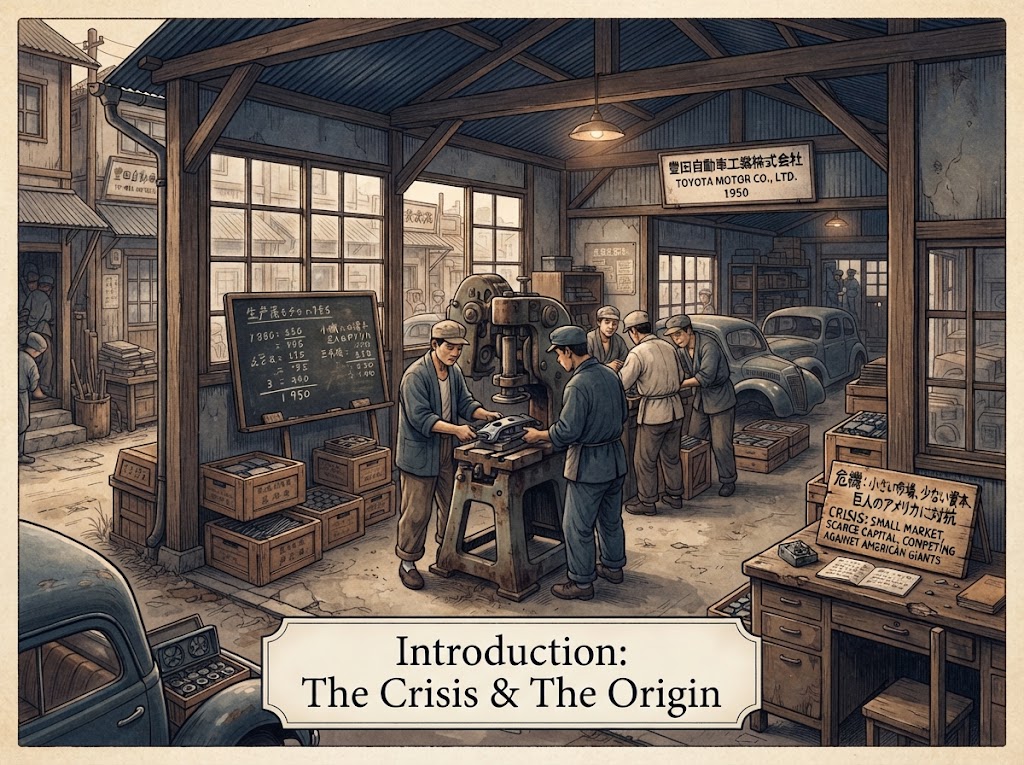
The Problem with the American Model
To understand what Toyota achieved, you first need to understand what it was up against. Henry Ford had invented mass production, and American carmakers had perfected it. Their approach was to build huge volumes of identical cars using massive machines, long assembly lines, and armies of specialized workers. Economies of scale made each car cheap, but only if you sold millions of them.
This model had a hidden weakness: it demanded enormous inventory. Parts were produced in huge batches and piled up in warehouses, waiting to be used. If a machine broke down or a design changed, all that inventory became waste. Ford could absorb that waste because the American market was enormous. Toyota, producing a few thousand cars a year for a small, demanding domestic market, could not afford that luxury.
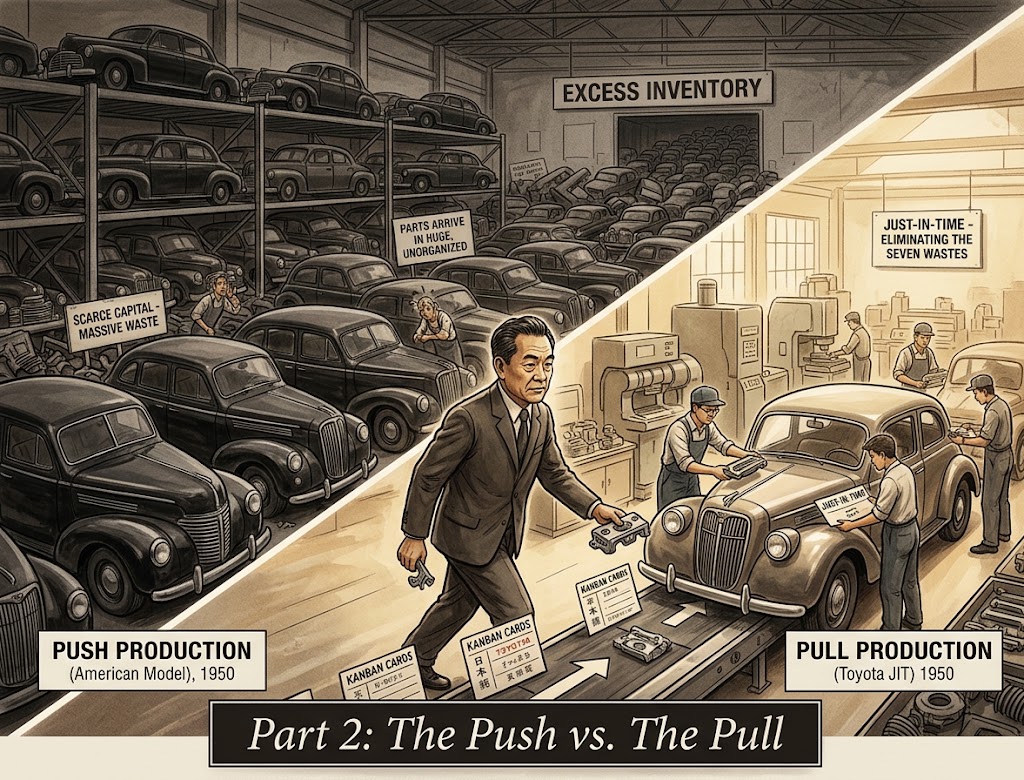
The man who grasped this problem was Kiichiro Toyoda, the founder of Toyota Motor Company. During a visit to the United States in 1929, he studied Ford’s factories closely. He took away an idea that would become the heart of the Toyota Production System: instead of pushing parts through the factory in huge batches, why not pull them through, one step at a time, exactly when they are needed?
Taiichi Ohno and the Birth of Just-in-Time
The architect who turned Kiichiro’s vision into a working system was Taiichi Ohno, a Toyota engineer who joined the company before World War II and spent decades refining its production methods. Ohno is often called the father of the Toyota Production System, and his achievements are remarkable, especially considering the conditions he worked in.
After World War II, Japan was devastated. Materials were scarce, capital was almost nonexistent, and Toyota could not afford big warehouses, expensive machines, or large batches of anything. Ohno’s answer was to eliminate waste wherever it appeared. He identified seven types of waste: overproduction, waiting, transportation, over-processing, excess inventory, unnecessary motion, and defects. The goal was to hunt down and remove every single one.
His most famous invention is just-in-time production. In a just-in-time system, a part arrives at the assembly line at the exact moment it is needed, no earlier and no later. This sounds simple, but it requires a level of coordination that is almost musical. Each workstation produces only what the next station is ready to consume. The factory becomes a chain of precise handoffs rather than a series of independent production silos.
Just-in-time also exposed problems instead of hiding them. In a traditional factory, if a machine makes defective parts, the bad parts get buried in inventory and discovered weeks later. In a just-in-time system, there is no inventory to hide in. The problem stops the line immediately, and everyone must fix it before production can resume. That sounds painful, and it is, but it forces continuous improvement in a way that batch production never does.
Jidoka: Machines That Stop and Speak
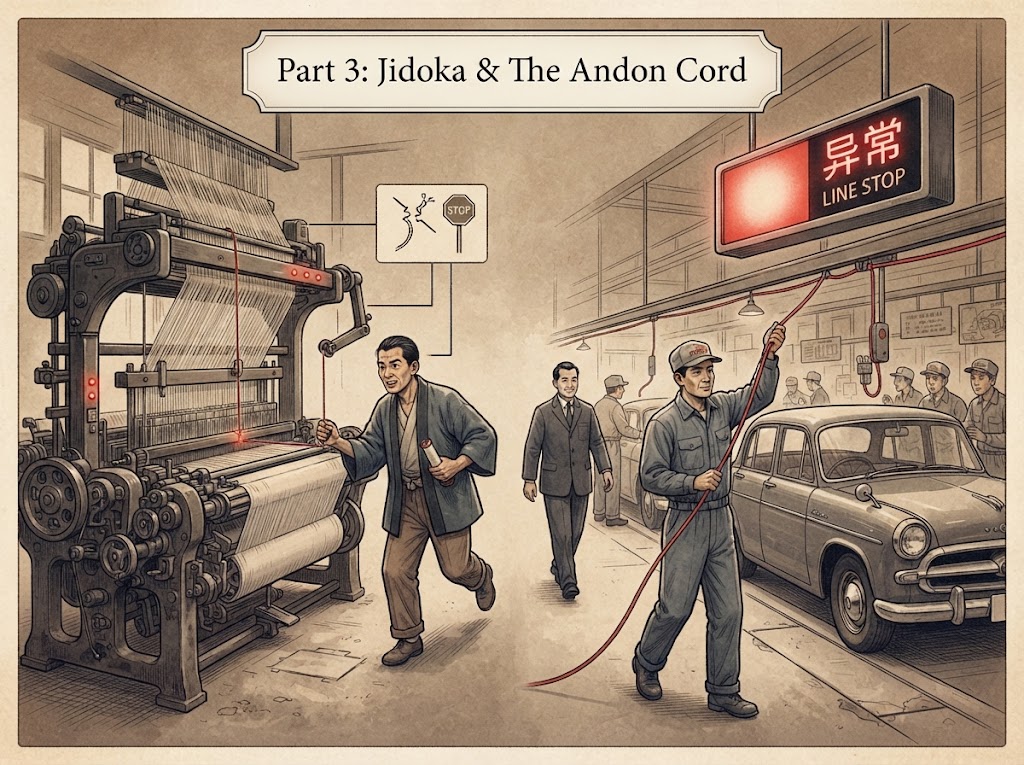
Just-in-time was only half of the Toyota Production System. The other half is a principle called jidoka, which roughly translates to “automation with a human touch.” The idea came from Sakichi Toyoda, the founder of the Toyota group and a loom maker by trade. Sakichi built an automatic loom that could detect when a thread broke and stop itself immediately, instead of producing yards of defective fabric.
Why does stopping sound so smart? Because a machine that keeps running while making defective parts is worse than a machine that stops. Jidoka gives machines the ability to detect abnormalities, stop themselves, and call for help. Workers are not expected to watch machines like babysitters; they are expected to fix problems and improve the process. This frees people to do what machines cannot: think.
Modern factories call this same idea “autonomation,” and it is one of the pillars of quality control. In the Toyota Production System, any worker can pull a cord called an andon to stop the production line if they spot a problem. Stopping the line is not a failure; it is the first step of fixing the problem permanently. This willingness to stop and fix rather than push through is a big reason Toyota quality became legendary.
Kanban and the Tools That Made It Work
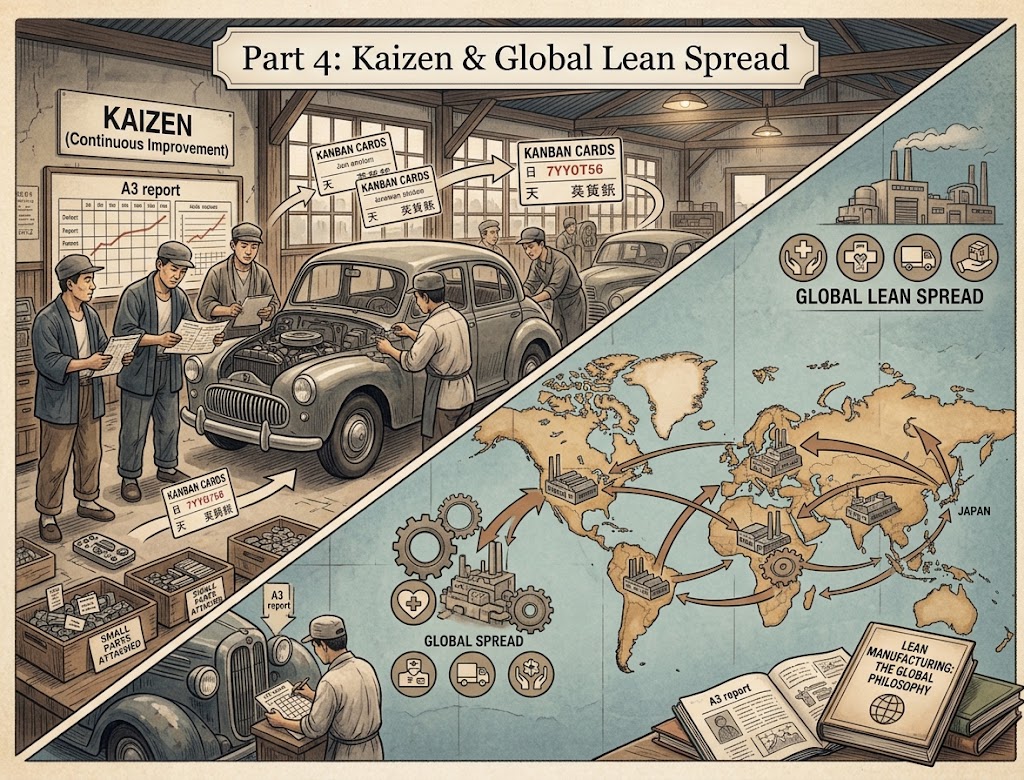
To keep just-in-time running, Toyota needed a simple way to communicate what to produce and when. The answer was the kanban, a card or signal that travels with parts and triggers production. When a workstation uses a part, it sends a kanban back to the previous station, which then produces exactly one replacement.
The kanban system is so elegant that it feels obvious in hindsight. It converts the factory into a network of small, self-regulating loops. No central computer is needed to manage the flow; the cards do the coordination. This idea later became famous around the world as one of the core lean manufacturing tools, and software development teams now use kanban boards to manage their work with the same pull logic.
Toyota also developed other tools that became pillars of lean manufacturing. The 5S method, which organizes the workplace through sort, set in order, shine, standardize, and sustain, creates the discipline and cleanliness needed for efficient flow. Kaizen, the practice of continuous improvement, turns every employee into a problem solver. Value stream mapping, introduced decades later, helps teams see the entire production flow and identify waste from raw material to customer.
How “Lean” Got Its Name
For decades, the Toyota Production System was an internal secret, studied mainly by Toyota’s suppliers and a handful of Japanese academics. That changed in 1990, when a team of MIT researchers led by James Womack and Daniel Jones published a book called “The Machine That Changed the World.”
The book, based on a massive study of the global auto industry, revealed that Toyota’s methods produced better quality, lower cost, and faster development with far fewer resources than any Western competitor. The researchers needed a word to describe this astonishingly efficient approach, and they chose “lean.” Lean manufacturing was born as a global movement.
What made lean so attractive is that its principles are universal. You do not need to build cars to use them. Hospitals use lean to reduce patient waiting times. Software teams use kanban and continuous improvement to ship better products. Airlines use lean thinking to turn planes around faster. The tools are the same ones Taiichi Ohno developed in a bombed-out Japanese factory: eliminate waste, produce on demand, stop and fix problems, and improve every day.
The Lessons of the Toyota Production System
The history of the Toyota Production System offers lessons that go far beyond manufacturing. The first is that constraints can be a gift. Toyota did not become great despite its limitations; it became great because of them. With no room for waste, it was forced to invent a system with almost no waste.
The second lesson is that people matter more than machines. Toyota’s system gives every worker the authority and the responsibility to improve the process. Lean manufacturing is not about automation replacing humans; it is about humans using their intelligence to get the most out of machines.
The third lesson is that quality and efficiency are the same thing. Toyota discovered that it is cheaper to build a part right the first time than to inspect, rework, and repair it later. Defects are not just errors; they are the most expensive form of waste there is.
Toyota is still refining its system today, and the wider world is still catching up. The Toyota Production System was the origin of lean manufacturing, and its principles, just-in-time, jidoka, kanban, kaizen, 5S, continue to shape factories, offices, and organizations everywhere. Not bad for a small Japanese carmaker that simply refused to waste anything.