
Why Suspension Bushings Wear Out: The Rubber That Holds Your Car Together
Somewhere under your car, dozens of small rubber-and-metal parts are quietly doing one of the toughest jobs in the automotive world. They’re called suspension bushings, and they connect the metal parts of your suspension together — control arms, sway bars, struts, and subframes. They’re small, they’re cheap, and when they wear out, your car feels loose, noisy, and unsafe. Here’s why bushings wear out, how to spot the warning signs, and what to do about it.
What exactly is a bushing?
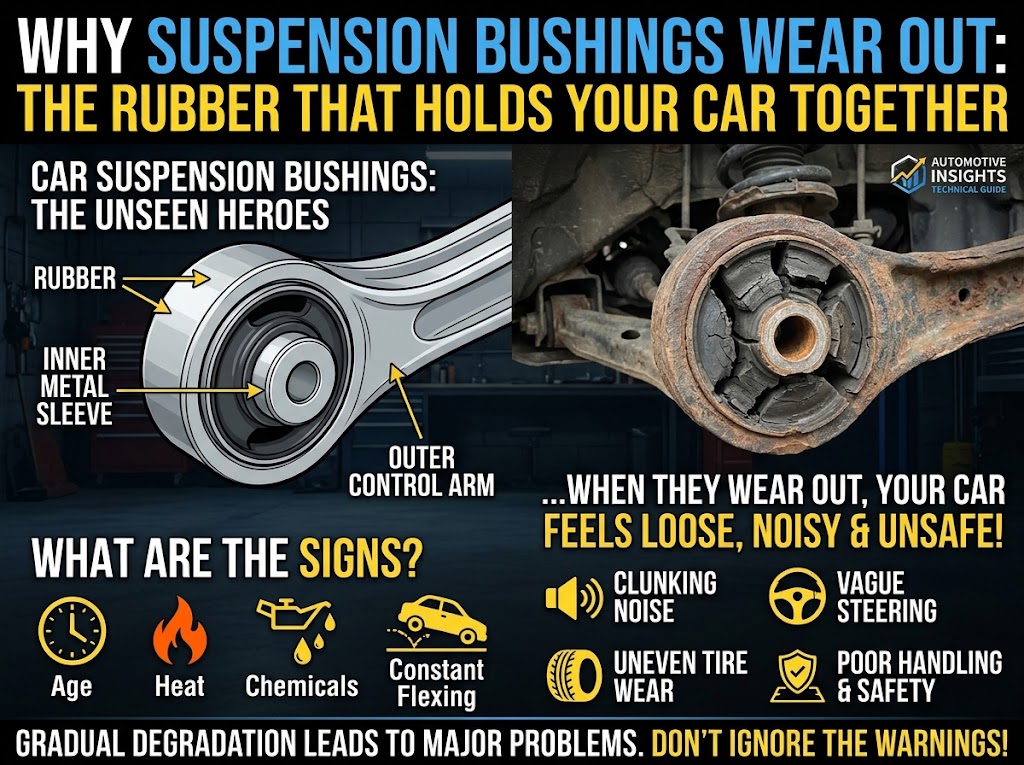
A bushing is a cylindrical cushion, usually made of rubber (or polyurethane) bonded to a metal sleeve or mounted between two metal parts. It sits at the pivot points of the suspension, allowing parts to move slightly while absorbing vibration, noise, and shock.
Think of bushings as the joints in your car’s skeleton — like the cartilage in your knees. They let the metal parts flex and pivot without grinding against each other, and they filter out the harshness of the road so you don’t feel every pebble.
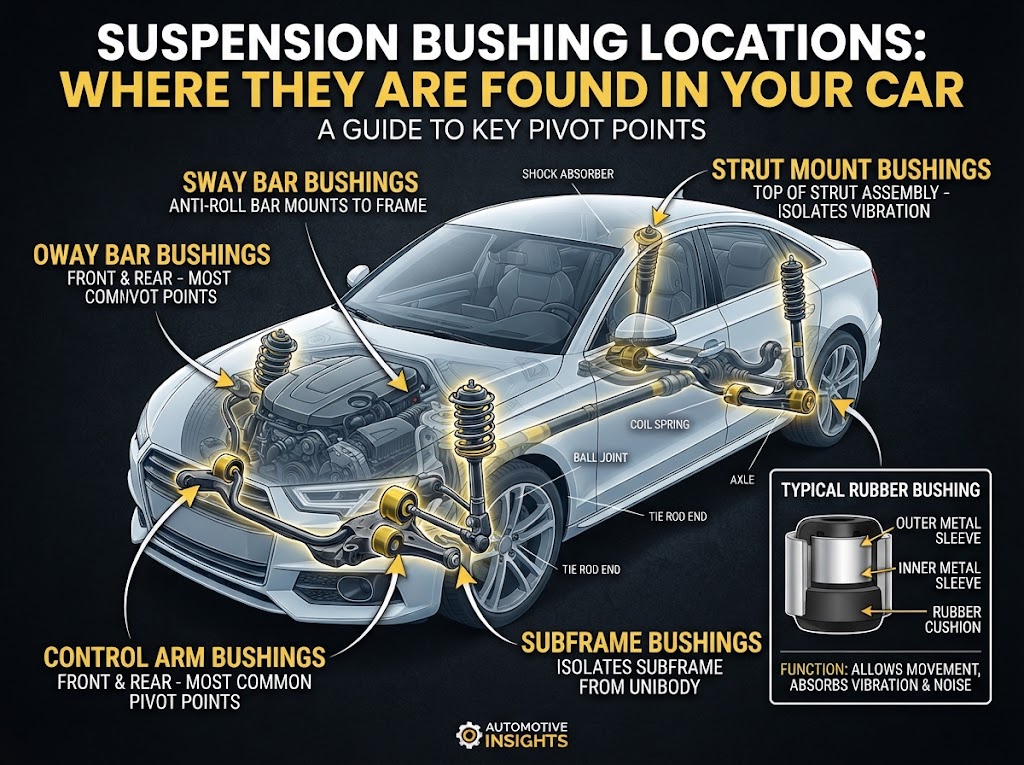
Where will you find them? Everywhere:
Control arm bushings (front and rear) — the most common.
Sway bar bushings — where the anti-roll bar mounts to the body.
Strut mount bushings — at the top of MacPherson struts.
Subframe bushings — where the subframe mounts to the body.
Engine and transmission mounts — technically the same technology, isolating the drivetrain.
What does a bushing do?
Bushings do four critical jobs:
They allow controlled movement. The suspension needs to move up, down, and slightly sideways as the wheels travel. Bushings permit that movement while keeping parts aligned.
They absorb vibration and noise. Rubber is a natural damper — it eats road noise and high-frequency vibration before they reach the cabin.
They prevent metal-on-metal wear. Without bushings, metal pivot points would grind against each other and wear out quickly.
They tune handling. Bushings have a specific stiffness that contributes to how the car corners, brakes, and tracks. Softer bushings = more comfort; stiffer bushings = sharper handling.
Why do bushings wear out?
Bushings are made of rubber, and rubber has a finite life. The main culprits:
Age and oxidation. Rubber degrades over time, even without driving. It dries out, hardens, and cracks — the same thing that happens to old rubber bands. A 10-year-old bushing is rarely as good as a new one, no matter the mileage.
Heat. Bushings live near the engine, exhaust, and brakes — all sources of heat. Repeated heat cycling hardens and cracks the rubber.
Chemicals. Oil leaks, brake fluid, road salt, and fuel vapors attack rubber. A leaking engine or transmission can literally eat the bushings below it.
Constant flexing. Every bump, corner, and braking event flexes the bushings millions of times. Rubber fatigues, and cracks form and grow.
Overload and abuse. Potholes, curbs, heavy loads, and aggressive driving stress bushings beyond their design limits.
Polyurethane aftermarket parts wear differently — they’re stiffer and longer-lasting than rubber, but they transmit more noise and vibration and can squeak.
Symptoms of worn bushings
Worn bushings announce themselves in several ways:
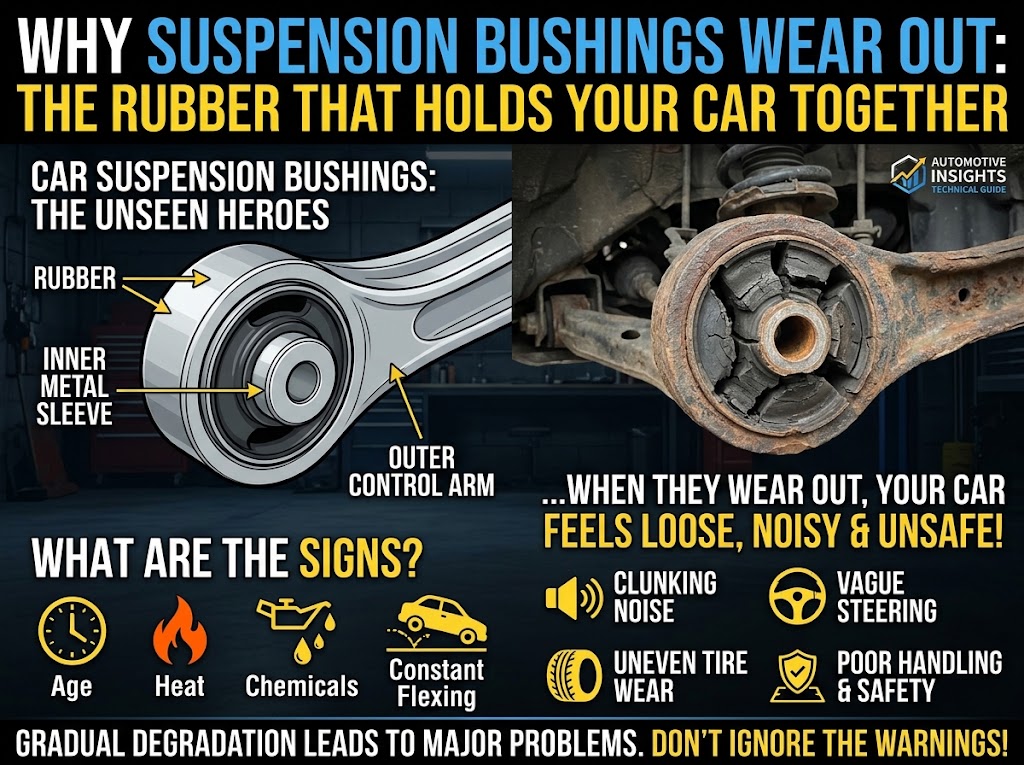
Clunking or knocking from the suspension over bumps — the classic symptom. The metal parts are moving beyond the bushing’s control.
Creaking or squeaking, especially when turning slowly or going over speed bumps.
Vague or wandering steering. The wheel feels loose, and the car drifts on the highway.
Uneven tire wear. A worn bushing lets the wheel shift out of alignment.
A rear end that feels loose or unstable over rough roads.
Visible cracks or splits in the rubber if you inspect the bushings.
The tricky part: bushing wear is gradual, so many drivers don’t notice until the car feels noticeably sloppy — or a mechanic points it out during an inspection.
What happens if you ignore them?
Worn bushings don’t just make noise — they cause real problems:
Accelerated tire wear. Misaligned wheels scrub tires fast, and tire costs add up quickly.
Damaged suspension parts. When a bushing fails, the metal parts it protects start moving against each other, wearing out ball joints, control arms, and mounts.
Poor handling and safety. Loose suspension means less predictable behavior in an emergency maneuver — longer braking, slower reactions, less grip.
Failed alignment. You can align a car with worn bushings, but it won’t hold; the wheels shift again as soon as the bushings flex.
How are bushings replaced?
Replacing bushings ranges from easy to involved, depending on location:
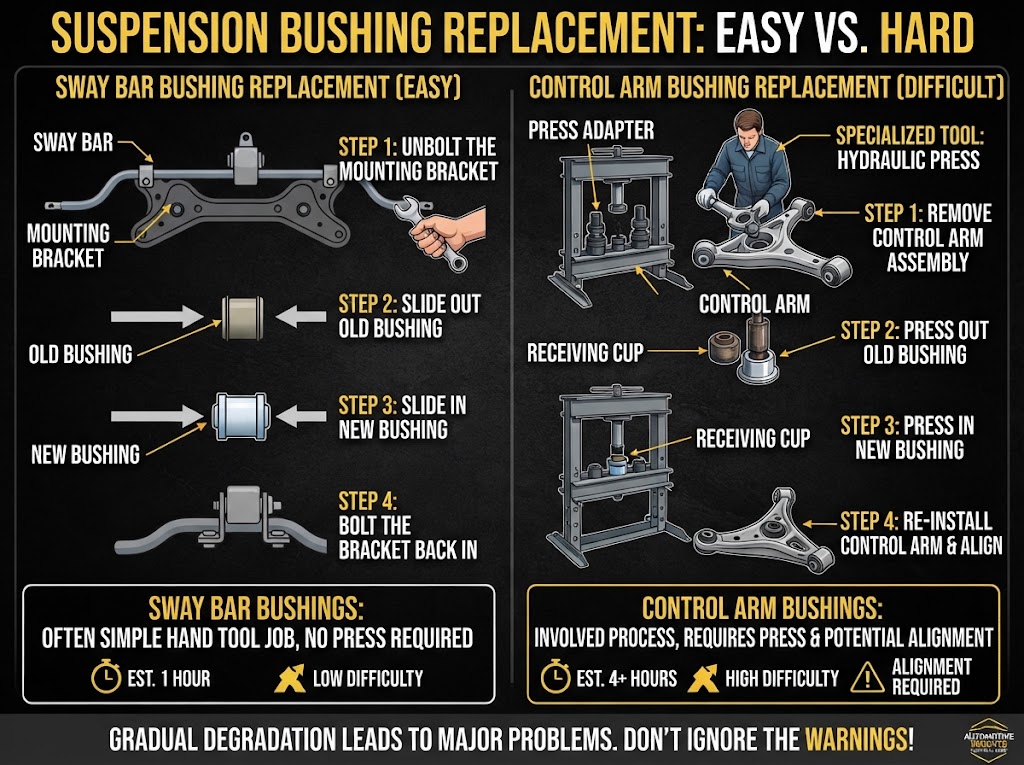
Sway bar bushings are often easy — unbolt the mount, slide out the old bushing, slide in the new one.
Control arm bushings are harder. The control arm has to come out, and the old bushing is pressed out and the new one pressed in — often with a hydraulic press. On many modern cars, it’s cheaper and easier to replace the whole control arm with new bushings pre-installed.
Subframe bushings are a big job — the subframe has to be lowered or removed.
Expect a control arm bushing replacement to cost a few hundred dollars per side including labor, more on premium cars. After any bushing work that affects alignment, a four-wheel alignment is essential.
How to inspect bushings yourself
You don’t need a lift to get a rough idea of your bushings’ health. Park on a level surface, grab a flashlight, and look at each wheel area from the side and front. You’re checking the rubber parts where the control arms, sway bar, and struts meet the body or subframe.
What you’re looking for: cracks in the rubber (surface cracks are common and not always serious; deep splits that go through the rubber are a problem), bulges or tears, and any sign the metal sleeve is moving separately from the rubber. Another classic test is the “wiggle test” at the shop — with the car raised, a mechanic pries on the control arm with a bar; if the bushing allows visible movement, it’s worn.
You can also feel for bushings from the driver’s seat. If you hear a dull clunk over speed bumps, feel a slight shimmy in the steering, or notice the car wandering on grooved highways, worn bushings are a strong suspect. Add an occasional look at tire wear: scalloped or cupped edges are the signature of loose suspension, and worn bushings are one of the usual causes. A five-minute look under the car every few months catches most bushing problems long before they become expensive.
Preventing bushing wear
You can’t stop rubber from aging, but you can slow it down:
Fix oil and fluid leaks promptly. Leaking fluids are bushing killers.
Wash the undercarriage in winter to remove road salt.
Avoid potholes and curbs.
Keep loads reasonable.
Replace in pairs — when one side’s bushings are worn, the other side usually isn’t far behind.
Choose the right replacement. If you’re replacing bushings, quality matters. Cheap rubber bushings can fail fast, and polyurethane — while longer-lasting — transmits more road noise and can squeak without proper lubrication. For a daily driver, a quality OEM-spec rubber bushing is almost always the right call. And when a control arm includes a ball joint and bushings, replacing the complete arm often costs barely more than pressing in new bushings — and saves labor time.
Quick FAQs
How long do suspension bushings last? Typically 60,000 to 100,000 miles, but age, climate, and road conditions can shorten that significantly.
Can I drive with worn bushings? Yes, but it’s not smart — handling suffers and other parts wear faster. Get them replaced before they fail.
Rubber or polyurethane? Rubber for comfort and silence; polyurethane for longer life and sharper handling at the cost of noise and harshness. Most daily drivers should stick with rubber.
Why does my car creak when I turn? Often a dry or worn sway bar bushing, or a ball joint — worth a quick inspection.
Conclusion
Suspension bushings are the small rubber joints that hold your car together — absorbing vibration, guiding suspension movement, and keeping your tires planted. They wear out slowly, from age, heat, chemicals, and constant flexing, and their failure shows up as clunks, loose steering, and uneven tires. The fix is cheap and routine, and catching it early saves your tires, your other suspension parts, and your safety. Give your bushings a thought — and a check — the next time your car doesn’t feel quite right.