How “Made in Germany” Went from a Copycat Label to a Global Quality Icon
Today, “Made in Germany” is shorthand for precision, reliability, and engineering excellence. German cars, machine tools, and industrial equipment enjoy a reputation that manufacturers around the world envy. But here is the twist: the label was not created as a badge of honor. It was invented by the British in 1887 as a warning. They wanted to protect British shoppers from cheap German imitations. A century later, that insult had become one of the most valuable marketing assets in the history of manufacturing. The German manufacturing history behind this transformation is one of the most fascinating turnarounds in the industrial world.
The Insult That Started It All
To understand the origin of “Made in Germany,” you have to look at the late 19th century. Germany was a young nation, having unified only in 1871, and it was industrializing at a furious pace. British factories, by contrast, had enjoyed nearly a century of dominance. They were the world’s workshop, and they were confident, perhaps too confident.
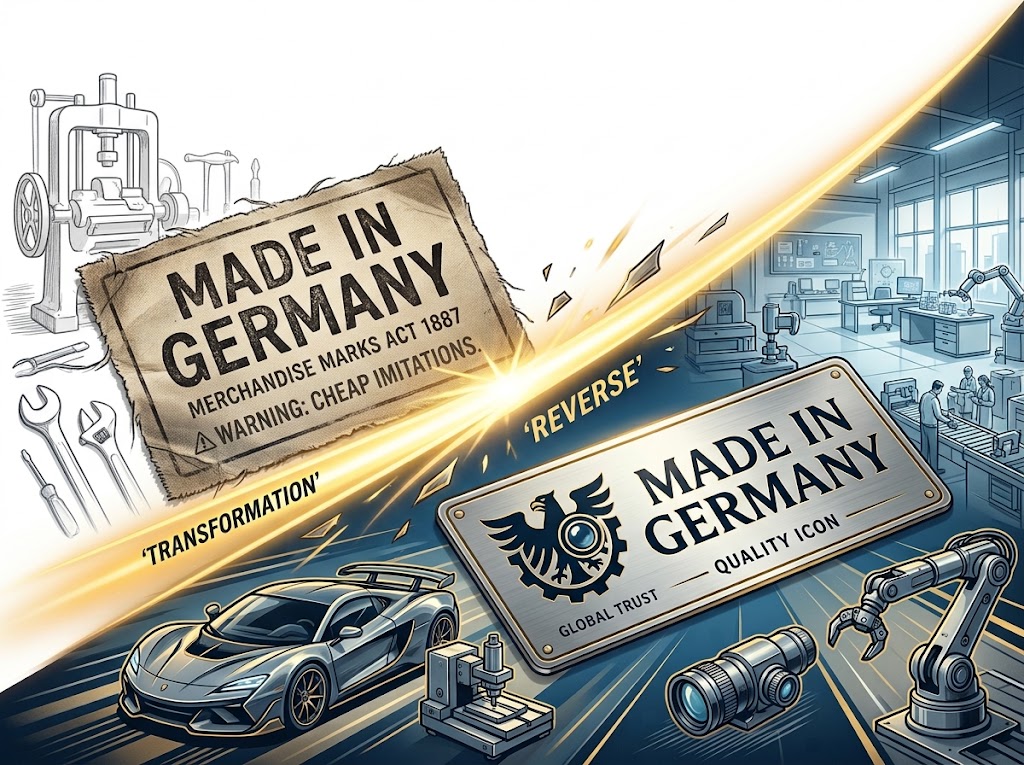
German manufacturers of the era often did what latecomers do: they copied. They produced scissors, knives, toys, textiles, and machine parts that imitated British designs and sometimes carried British-style packaging and names. Some of it was decent; a lot of it was cheap and flimsy. British consumers started complaining, and Parliament responded in 1887 with the Merchandise Marks Act, which required foreign goods to be clearly labeled with their country of origin. The intent was simple: let buyers know that the shiny product in the shop window came from Germany, not Sheffield or Birmingham.
It was, in effect, a quality warning label. And for a while, it worked as intended. “Made in Germany” became a punchline, a synonym for shoddy knockoffs.
How the Germans Flipped the Script
What happened next is the remarkable part. Instead of fighting the label, German industry decided to make it true. A combination of factors drove the change: strong technical education, close ties between science and industry, and a willingness to focus on engineering and quality rather than cheap imitation.
Germany had something many industrial nations lacked: a world-class education system that treated technical training with the same seriousness as academic study. Institutions like the Technische Hochschulen churned out engineers who understood both theory and shop-floor practice. Apprenticeship programs ensured that skilled workers were genuinely skilled. Meanwhile, research laboratories inside companies like Siemens, BASF, and Bosch turned chemistry and physics into marketable products.
German firms also chose to compete in areas where quality mattered more than price. Instead of racing the British on low-cost textiles and consumer goods, they focused on heavy machinery, chemicals, electrical equipment, optics, and precision instruments. These were products where a customer who bought a bad one learned a very expensive lesson, so reliability was worth paying for. Slowly, the label that had been designed to warn shoppers began to mean the opposite.
By the early 20th century, “Made in Germany” was appearing on machine tools, scientific instruments, and electrical equipment that were not just competitive but often superior. The insult had become an asset.
The Mittelstand: The Quiet Engine of German Quality
Ask most people why German manufacturing is so good, and they will probably mention famous brands: Volkswagen, BMW, Siemens, Bosch, Zeiss. But the real secret lies in the Mittelstand, the vast network of small and medium-sized companies that form the backbone of the German economy.
Many of these firms are family-owned, highly specialized, and quietly dominant in their niches. A Mittelstand company might make only industrial valves, or gearboxes, or a single type of sensor, but it might supply customers in eighty countries. These “hidden champions,” a term coined by management researcher Hermann Simon, rarely advertise to consumers, but their products are inside machines all over the world.
The Mittelstand model supports the German quality reputation in several ways. Long-term ownership means companies invest for decades, not quarters. Deep specialization means workers and engineers become extraordinarily knowledgeable about their narrow field. And because these firms often make capital equipment that must run for decades, they obsess over reliability, service, and spare parts.
Standards: The Invisible Hand
You cannot tell the story of German manufacturing history without talking about standards. Germany has one of the oldest and most respected standardization systems in the world. The DIN standards, developed by the German Institute for Standardization, cover everything from paper sizes to machine tool specifications.
Standards do more than create uniformity. They create trust. When an engineer in Brazil or Thailand specifies a DIN-standard component, they know exactly what they are getting, regardless of which German factory made it. This consistency is a huge competitive advantage. It means buyers can design, source, and maintain equipment with confidence, which is precisely the kind of confidence the “quality icon” reputation is built on.
The German approach to quality also extends to vocational training. The dual system, where apprentices split their time between school and the factory floor, produces technicians who understand not just how to operate a machine but why it works. This deep bench of skilled labor is one reason German factories can maintain such high quality while also adopting advanced technologies.
The Industrial Giants Behind the Reputation
The “Made in Germany” story is also the story of specific companies that turned engineering excellence into global brands. Siemens, founded in 1847, helped build Germany’s electrical infrastructure and became a symbol of reliable technology. BASF and Bayer turned chemistry into an industry, inventing synthetic dyes, pharmaceuticals, and plastics that transformed daily life. Bosch, born as a small workshop in Stuttgart, became a global leader in automotive components, pioneering innovations like the spark plug, the fuel injection system, and the anti-lock braking system.
Perhaps most emblematic is the automobile. Germany did not invent the car, but German engineers, from Karl Benz and Gottlieb Daimler to Ferdinand Porsche, defined what a great car could be. The automotive industry knit together every element of German manufacturing strength: precision machining, advanced materials, skilled labor, and rigorous testing. By the mid-20th century, German cars had a global reputation for durability and engineering, a reputation that the rest of German industry shared and reinforced.
These companies also created an ecosystem. When a large German firm succeeded, it pulled thousands of suppliers, toolmakers, and machine builders along with it. That ecosystem, dense, specialized, and interconnected, is a big part of why “Made in Germany” means more than a single factory’s output. It represents a whole national industrial culture.
Made in Germany Today
Today, “Made in Germany” is far more than a country-of-origin label; it is a brand. It appears on cars, machine tools, medical devices, and even fashion, and consumers consistently rank it among the most trusted origin labels in the world.
But the label is evolving. German industry is now at the center of Industry 4.0, the push to connect factories, machines, and data. The same commitment to precision is being applied to software, sensors, and digital services. German machine builders are wiring their equipment with data interfaces, offering predictive maintenance, and selling uptime and productivity rather than just hardware.
There are challenges, of course. High labor costs, energy prices, and global competition push German manufacturers to keep innovating. And the rise of high-quality manufacturing in Asia means the word “Made in” is no longer a reliable guide to quality on its own. Yet the German response to those challenges is consistent with the pattern set in 1887: compete on quality, invest in people, and turn pressure into an excuse to get better.
A Label with a Story
The next time you see “Made in Germany” stamped on a machine tool, a kitchen appliance, or a car, remember that the label began as a warning. It was supposed to tell shoppers to beware. Instead, it became a promise.
That is the real lesson of German manufacturing history. Reputations are not handed out; they are built, one reliable product at a time. The British gave Germany a label meant to hurt it, and German industry spent a century making that label mean something great. It may be the most successful brand-repair job in the history of manufacturing, and it is a reminder that quality, once earned, is the hardest asset in the world to copy.