
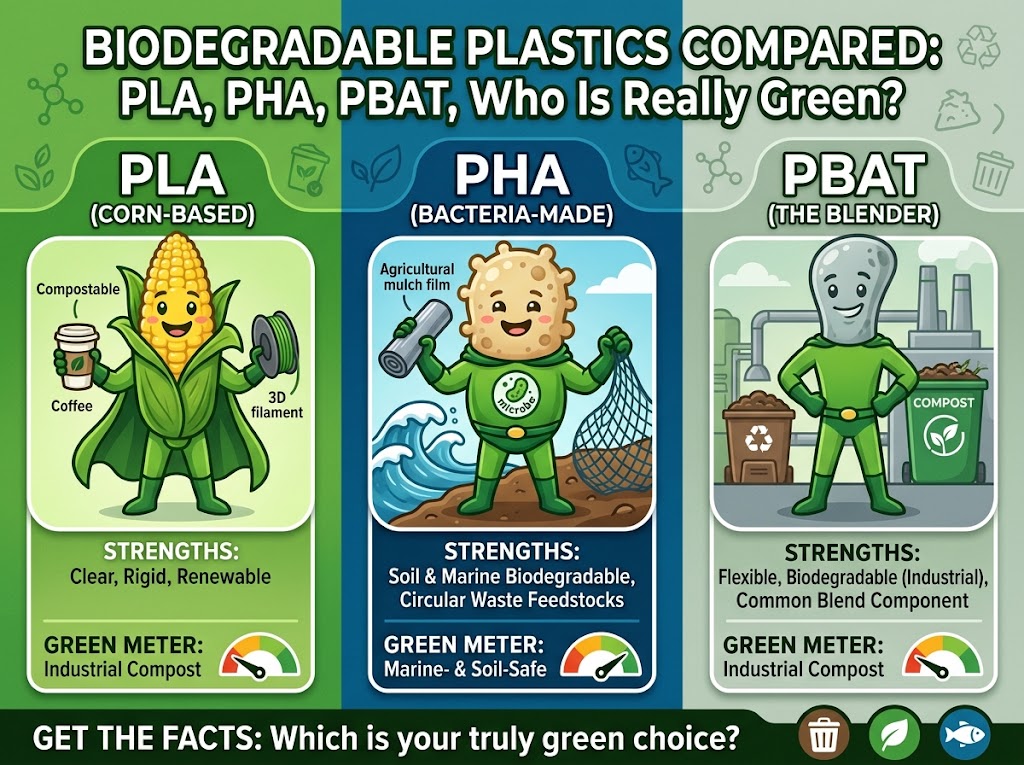
Biodegradable Plastics Compared: PLA, PHA, and PBAT, Who Is Really Green?
Plastic pollution has become one of the defining environmental problems of our time. We produce hundreds of millions of tons of plastic every year, and much of it ends up in landfills, rivers, and oceans, where it lingers for centuries. In response, a new generation of “biodegradable plastics” has arrived, promising to break down naturally and save the planet.
But here is the uncomfortable truth: not all biodegradable plastics are created equal. Some live up to their name, some only decompose in special industrial facilities, and some are marketed with more enthusiasm than accuracy. In this biodegradable plastics comparison, we will look at three of the most talked-about materials, PLA, PHA, and PBAT, and figure out who is genuinely green and who is just wearing a green costume.
First, Some Terminology
Before comparing materials, we need to clear up three words that are often used interchangeably but mean very different things: biodegradable, compostable, and bio-based.
Biodegradable means a material can be broken down by microorganisms into water, carbon dioxide, and biomass. But “biodegradable” says nothing about how long it takes or under what conditions. A plastic can be technically biodegradable while taking hundreds of years in a landfill.
Compostable is more specific. A compostable material must break down within a defined time frame, usually a few months, and leave no toxic residue. Industrial compostable plastics meet strict standards, like EN 13432 in Europe, but they may only compost in industrial facilities with controlled heat and microbes.
Bio-based means the material is made from renewable resources, like corn or sugarcane, rather than petroleum. Bio-based does not automatically mean biodegradable, and biodegradable does not automatically mean bio-based. These are three separate properties that can mix in many combinations.
PLA: The Famous Corn Plastic
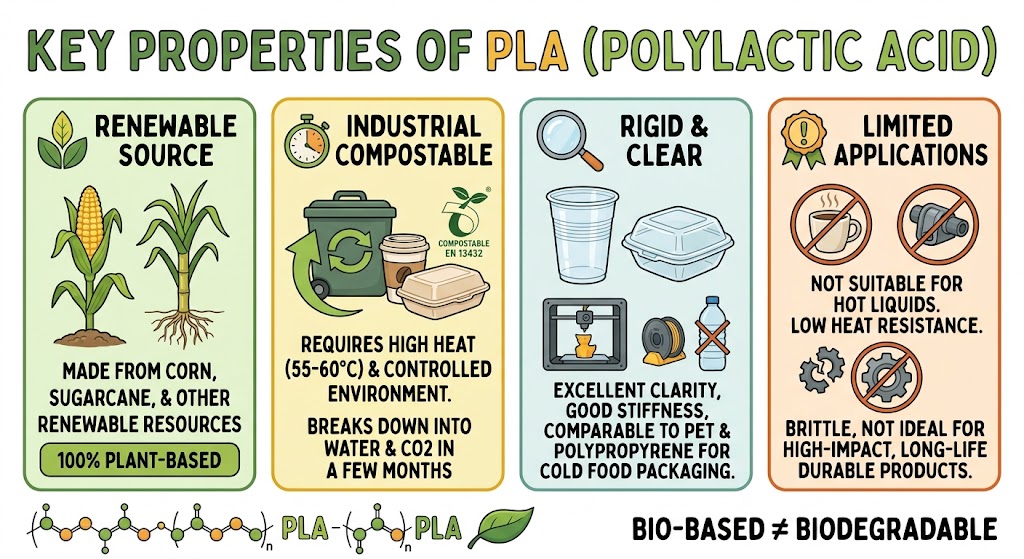
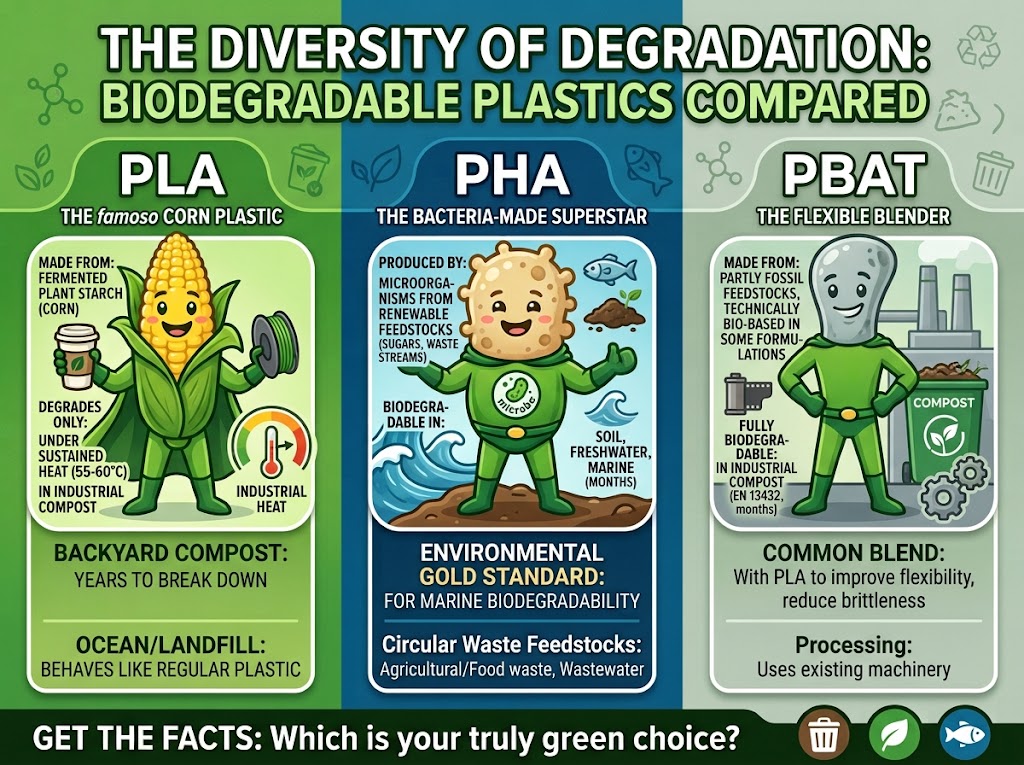
Polylactic acid, or PLA, is the rock star of biodegradable plastics. It is made from fermented plant starch, usually corn, and it is the material behind compostable cups, food packaging, and most “green” 3D printing filament.
PLA has real advantages. It is bio-based, made from renewable crops rather than oil. It is clear and rigid, making it a good substitute for PET in food containers and disposable cups. It has a low carbon footprint in production, and it looks and feels like conventional plastic.
Here is the catch: PLA only degrades under specific conditions. In a backyard compost pile, PLA can take years to break down. It needs the sustained heat, around 55-60°C, and the microbial environment of an industrial composting facility. If PLA ends up in the ocean or a landfill, it behaves very much like regular plastic for a very long time.
PLA is also not a drop-in replacement for every application. It has lower heat resistance than PET or polypropylene, so it cannot hold hot liquids or go in dishwashers. It is brittle, and it is not suitable for durable products. PLA is genuinely green when it is composted correctly, but “compostable in theory” can easily become “landfill in practice.”
PHA: The Bacteria-Made Superstar
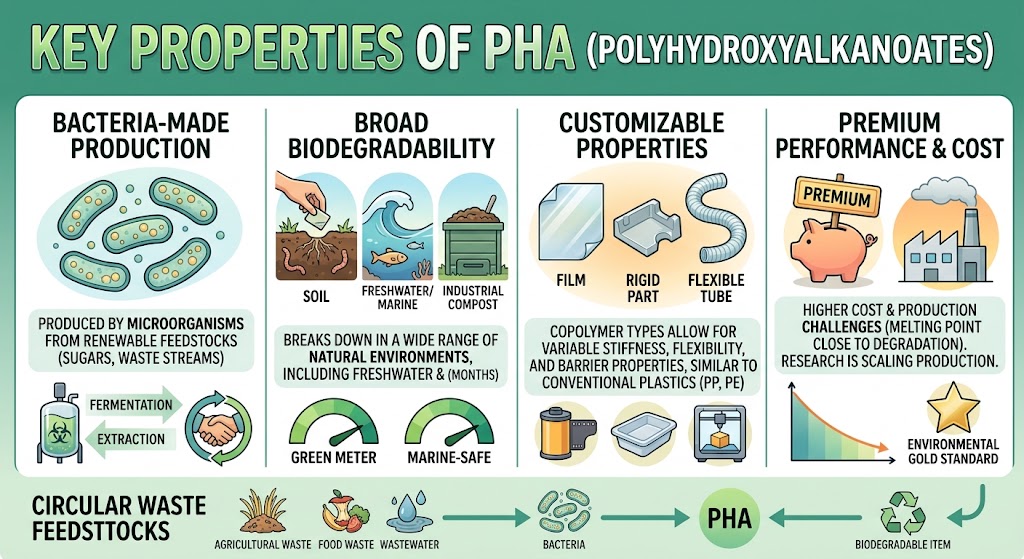
Polyhydroxyalkanoates, or PHA, are a family of bioplastics produced by bacteria. Instead of using plants as the raw material, PHA is made by microorganisms that store the polymer as energy, much like humans store fat. The bacteria are fed sugars or waste streams, and they produce PHA granules that can be harvested and processed into plastic.
PHA is remarkable because it is biodegradable in a much wider range of environments. Unlike PLA, PHA can break down in soil, freshwater, and even marine environments. Studies show PHA products degrading in seawater within months, which is exactly what you want for a material that might end up in the ocean.
That marine biodegradability makes PHA the environmental gold standard among biodegradable plastics. It is also bio-based, produced from renewable feedstocks, and some PHA processes can use agricultural waste, food waste, or even wastewater as inputs, closing the loop in a genuinely circular way.
The challenges with PHA are cost and processing. PHA is more expensive to produce than PLA, and it is more difficult to process into products because it degrades at temperatures close to its melting point. Manufacturers are investing heavily in scaling up PHA production, and costs are falling, but PHA remains a premium material.
For applications where marine or soil biodegradability matters, such as fishing gear, agricultural films, and single-use items that often escape into the environment, PHA is arguably the most genuinely green option available.
PBAT: The Flexible Blender
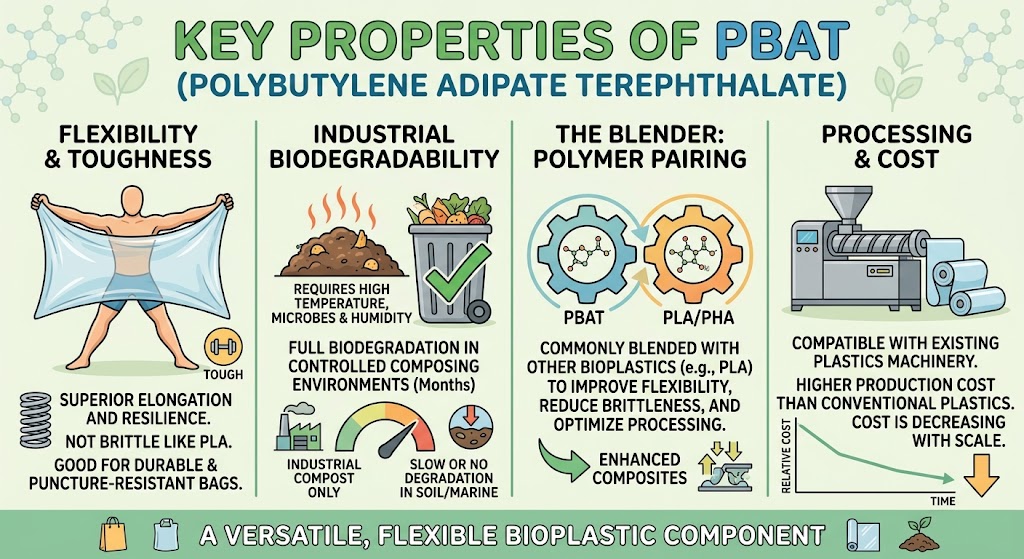
Polybutylene adipate terephthalate, or PBAT, is a different kind of bioplastic. It is technically bio-based in some formulations, but it is usually derived partly from fossil feedstocks. More importantly, PBAT is fully biodegradable under industrial composting conditions, and it has a special talent: flexibility.
PLA is rigid and brittle, which limits its uses. PBAT is soft and flexible, almost like polyethylene. By blending PBAT with PLA, manufacturers can create compostable films, bags, and flexible packaging that stretch and bend like conventional plastic. This is why most “compostable” shopping bags and food packaging are actually PLA-PBAT blends.
PBAT is the workhorse that makes compostable flexible packaging possible. On its own, it is not very strong and can feel sticky or greasy, but blended with PLA, it produces films that meet compostability standards and perform well in real applications.
The downside is that PBAT is often not fully bio-based, relying on fossil-derived components, and like PLA, it requires industrial composting to break down. It will not disappear in your backyard compost or in the ocean. It is a useful tool, but its green credentials depend heavily on the waste infrastructure available.
The Head-to-Head Comparison
Let’s put PLA, PHA, and PBAT side by side.
Bio-based content: PLA and PHA are fully bio-based. PBAT is partially bio-based, depending on the formulation, and often contains fossil-derived components.
Biodegradability range: PHA wins. It degrades in soil, freshwater, and marine environments. PLA and PBAT only degrade reliably in industrial composting facilities.
Industrial compostability: All three can meet compostability standards in industrial facilities, though PHA’s marine and home compostability gives it extra credit.
Mechanical properties: PLA is rigid and clear. PBAT is flexible, and blends with PLA create practical films. PHA is versatile but trickier to process.
Cost: PLA is the cheapest and most established. PBAT sits in the middle. PHA is the most expensive, though costs are falling as production scales.
Environmental impact: The answer depends on the waste path. In a well-managed industrial composting system, PLA and PBAT perform well. In uncontrolled environments, PHA is the clear winner because it actually breaks down.
The Real Green Question
Here is the uncomfortable reality behind this biodegradable plastics comparison: the material is only part of the story. A compostable cup that ends up in a landfill is no better than a regular cup. The environmental benefit of biodegradable plastics depends on collection, sorting, and processing infrastructure that most cities simply do not have yet.
This is why experts emphasize the waste hierarchy: reduce, reuse, then recycle, with biodegradability as a last resort for items that truly cannot be managed. Biodegradable plastics are not a license to consume more; they are a better option for specific applications where plastic inevitably escapes into nature, like agriculture films, fishing nets, or food packaging in places with composting systems.
There is also the question of feedstock. Growing corn for PLA competes with food production and uses land, water, and fertilizer. PHA made from waste streams avoids that competition, which is a significant environmental advantage.
What Should You Choose?
If you are a manufacturer, a policymaker, or a consumer trying to make sense of the green claims, here is practical guidance.
For rigid food packaging that will be industrially composted, PLA is a solid, cost-effective choice. For flexible bags and films that need to meet compostability standards, PLA-PBAT blends are the industry standard. For products likely to end up in the environment, whether in the ocean, soil, or freshwater, PHA is the only option that truly delivers on its biodegradable promise.
And for everyone, the most important question is not “which plastic is green?” but “where will this item end up?” A material’s environmental performance is determined by the waste system as much as by its chemistry.
The Future of Biodegradable Plastics
The bioplastics industry is growing fast, driven by regulation, consumer pressure, and corporate sustainability commitments. PHA production capacity is expanding, with new facilities in Europe, Asia, and the Americas. Researchers are improving PLA’s heat resistance and finding better ways to recycle it. And companies are developing bio-based PBAT and other blends that push the entire family toward renewable feedstocks.
The PLA vs PHA vs PBAT story is still being written, and the next chapters will depend as much on waste infrastructure and policy as on chemistry. But one thing is clear: the days when “plastic” meant one thing are over. The plastic family now includes materials with very different environmental footprints, and choosing wisely, and disposing correctly, is the most powerful green action any of us can take.