Digital Twins in Manufacturing: How Virtual Worlds Optimize Real Production
Imagine being able to test a change to your factory without touching a single machine. Imagine seeing inside a running production line, every sensor, every temperature, every vibration, without walking onto the floor. Imagine predicting next week’s bottleneck, or replaying last week’s breakdown to find its cause. This is not science fiction. It is what digital twin manufacturing makes possible.
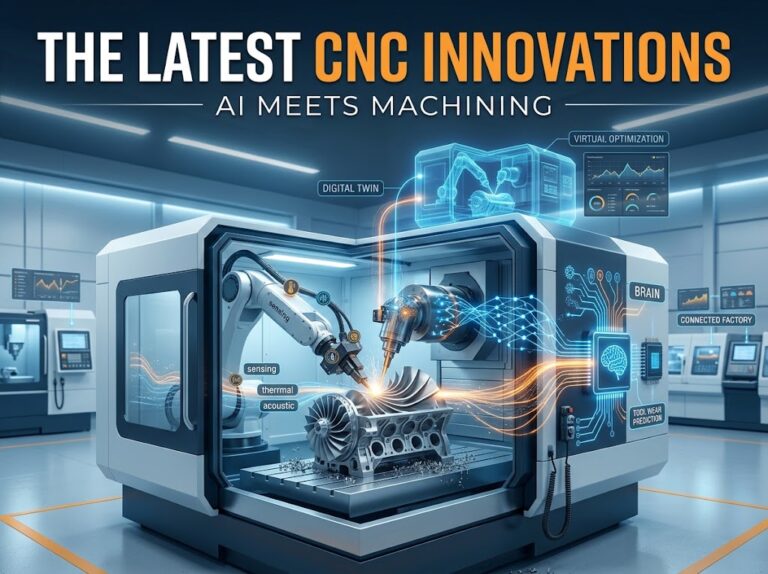
A digital twin is a virtual replica of a physical asset, process, or entire factory, connected to the real world and updated continuously with data. It is not a static 3D model; it is a living simulation that mirrors reality in real time. And it is one of the most powerful tools in the Industry 4.0 toolkit. Let’s explore what digital twins are, how they work, and why they are transforming manufacturing.
What Is a Digital Twin?
The term “digital twin” was coined in 2002 by Michael Grieves, then a professor at the University of Michigan, and popularized by NASA, which used the concept to maintain spacecraft. The idea is simple: create a digital counterpart of a physical system, and keep it synchronized with reality.
A digital twin has three components. The first is the physical asset itself: a machine, a production line, a building, or a whole factory. The second is the virtual model, a digital representation that captures the asset’s geometry, behavior, and data. The third is the connection between them, the sensors, networks, and software that keep the twin in sync with reality.
The twin is updated continuously. When the real machine’s temperature rises, the twin’s temperature rises. When a sensor reports a worn tool, the twin reflects it. The twin becomes a real-time mirror, and because it is digital, it can do things the physical asset cannot: run simulations, test scenarios, and explore the future.
There are different levels of digital twins. A digital shadow is a one-way connection, where data flows from the physical asset to the model. A digital twin proper has a two-way connection, where the model can also influence the physical asset. And a digital thread connects the twin across the product’s entire lifecycle, from design to manufacturing to operation.
How Digital Twins Work in a Factory
In manufacturing, a digital twin typically starts with the machine. Sensors measure spindle speed, temperature, vibration, power draw, and position. This data streams to the twin, which runs a physics-based simulation of the machine in real time.
The twin can predict what will happen next. If the vibration signature changes, the twin can identify the likely cause, a worn bearing, an unbalanced tool, an approaching collision, and forecast the impact on the process. Operators see alerts on dashboards, and engineers dig into the twin to diagnose issues.
At the production line level, the twin simulates the flow of parts, machines, and operators. It can model throughput, identify bottlenecks, and test scheduling changes. A line manager can ask: what happens if we add a second shift on this machine, or move this operation to another line? The twin answers in seconds, without disturbing production.
At the factory level, the twin becomes a complete digital representation of the plant: equipment, processes, energy flows, and logistics. It supports strategic decisions like layout changes, capacity planning, and investment analysis. It is the factory’s nervous system, constantly collecting, analyzing, and predicting.
Digital Twin Manufacturing in Action
Digital twins are already delivering results in real factories. One of the most common applications is predictive maintenance. A digital twin of a critical machine monitors its health continuously, and when the model detects the early signs of failure, maintenance is scheduled before the breakdown. This is dramatically cheaper than reactive maintenance, which stops production unexpectedly, and more efficient than preventive maintenance, which replaces parts on a fixed schedule regardless of condition.
Another application is production optimization. The twin simulates different production schedules, machine settings, and part sequences, and identifies the configuration that maximizes throughput or minimizes energy use. Engineers can experiment freely in the virtual world, where mistakes cost nothing, and apply only the winning strategies to the real factory.
Digital twins also support new product launches. Before a new product enters production, engineers build a digital twin of the production line, simulate the entire manufacturing process, and work out the problems in advance. Launch times shrink, and first-pass quality improves.
The energy and sustainability benefits are significant too. The twin models energy consumption and identifies waste. Some factories use digital twins to optimize heating, cooling, and machine scheduling, cutting energy costs by double digits.
The Flight Simulator Effect
There is a reason engineers call digital twins “flight simulators for manufacturing.” Pilots train in simulators because crashing a virtual airplane is free, and the same logic applies to factories.
Training operators on a digital twin lets them practice procedures, learn the machine, and handle emergencies without risk. A new operator can run the virtual production line, make mistakes, and understand the consequences before touching real equipment.
The twin also enables what-if analysis. What if we change this material? What if this machine fails for an hour? What if demand doubles next month? Each question is a simulation run, and the answers guide real decisions. This capability turns manufacturing from a reactive discipline into a predictive one.
The best digital twins become organizational knowledge. When experienced operators retire, their knowledge lives on in the twin’s models and simulations. The twin captures not just the process data, but the understanding of how the system behaves, which is priceless.
Building a Digital Twin: The Practical Path
Building a digital twin does not happen overnight, and it does not require a fully automated factory. Most manufacturers start small and scale up.
The first step is instrumentation: add sensors to critical machines and collect data. The second step is modeling: build a simulation of the machine or process, using physics, machine learning, or a combination. The third step is connection: stream real data into the model and validate that the twin matches reality.
The validation step is crucial. A twin that does not accurately reflect the physical asset is worse than useless; it is misleading. Engineers compare the twin’s predictions with real measurements, refine the model, and build confidence gradually.
The technology stack includes edge devices that collect sensor data, cloud platforms that store and process it, and simulation software that runs the models. Increasingly, AI is embedded in the twin, learning from data to improve predictions. Open standards and APIs allow twins to connect with ERP, MES, and other enterprise systems.
The Challenges
Digital twins face real challenges. Data quality is the biggest: a twin is only as good as the sensors and data feeding it. Missing, inaccurate, or delayed data degrades the model’s predictions.
Cost is another barrier. Sensors, software, and expertise are not cheap, though prices are falling. Many manufacturers start with a single critical asset rather than an entire factory, proving the value before scaling.
Integration is hard. Factories contain equipment from many vendors, with different protocols and data formats. Connecting everything into a coherent twin requires middleware and standardization.
Cybersecurity matters more as factories become connected. A digital twin is a valuable target, both for its data and for its potential to influence physical systems. Security must be designed in from the start.
And there is the cultural challenge: engineers and managers must learn to trust virtual models. This trust is earned through validation, transparency, and demonstrated results.
The Future of Digital Twin Manufacturing
Digital twins are on a steep growth curve. Sensors are getting cheaper, cloud computing is getting more powerful, and AI is making models smarter. The trend is toward whole-factory twins, where every asset, process, and flow is represented digitally.
The next frontier is the “living twin,” which continuously learns and improves itself. Instead of a model built once and updated manually, the living twin uses machine learning to refine its predictions from every new data point. It becomes more accurate the longer it runs.
Digital twins are also expanding across the supply chain. A twin of a supply network can simulate disruptions, evaluate alternative suppliers, and optimize logistics in real time. In a world of frequent disruptions, this capability is increasingly valuable.
For manufacturers, the message is clear: the virtual world is becoming a competitive weapon. Digital twin manufacturing is not a technology to admire; it is a technology to use. Companies that build accurate, living digital twins of their operations will respond faster, waste less, and outperform those that rely on hindsight.
The Bottom Line
The digital twin is the factory’s mirror, its crystal ball, and its flight simulator rolled into one. It lets manufacturers see the present with perfect clarity, predict the future with increasing confidence, and test the unknown without risk.
From predictive maintenance to production optimization, from operator training to supply chain resilience, digital twin manufacturing is transforming how factories are run. The machines on the floor have always been physical; now they have digital shadows, and those shadows are quietly making the real world smarter. The factory of the future is not just automated; it is simulated, optimized, and understood, before anything goes wrong.