Manufacturing in 2030: 5 Trends That Will Reshape the Industry
Manufacturing is often described as the foundation of the economy, and like every foundation, it is being rebuilt. The factories of 2030 will look very different from the factories of today. The change will not come from a single breakthrough; it will come from the convergence of several powerful trends, each reinforcing the others.
Forecasting is risky, but the direction is clear. By 2030, manufacturing will be more intelligent, more automated, more sustainable, more localized, and more human-centric. These five manufacturing trends will reshape the industry, and companies that understand them today will be positioned to lead tomorrow.
1. AI Everywhere: From Assistants to Autonomy
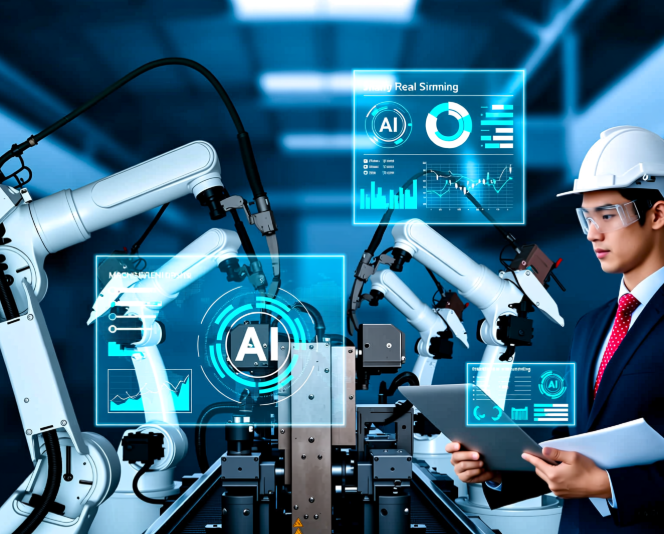
The first trend is the deepening integration of artificial intelligence into every layer of manufacturing. AI is already inspecting parts, predicting maintenance, and optimizing schedules; by 2030, it will be the operating system of the factory.
The shift will be from AI that recommends to AI that acts. Autonomous production scheduling will manage the factory in real time, rerouting work around disruptions. AI quality systems will not just catch defects; they will adjust processes to prevent them. Predictive maintenance will evolve into prescriptive maintenance, with AI orchestrating the entire repair workflow.
Generative AI will become a standard tool. It will write work instructions, generate code for machines, answer questions from maintenance logs, and help engineers design products. The interface between humans and complex systems will be conversational, and the barrier to using AI will fall dramatically.
The result will be factories that are more efficient, more flexible, and more responsive, with AI handling the routine decisions and humans handling the judgment calls. The companies that master the human-AI partnership will outperform those that either resist or blindly trust the technology.
2. The Rise of the Autonomous Factory
The second trend is the expansion of lights-out manufacturing. By 2030, unattended production will be the norm for many processes, not the exception.
The economics are driving this. Machines are expensive, labor is scarce, and running equipment 24/7 multiplies the return on investment. As robots, sensors, and AI improve, the hours that factories can run without people will grow steadily.
The autonomous factory of 2030 will not be completely empty. It will be a hybrid: robots and machines handle the routine work, day and night, while skilled humans handle setups, exceptions, and continuous improvement. The night shift will belong to the machines, and the day shift will be smaller, more skilled, and more strategic.
The trend will spread unevenly. Precision machining, electronics, pharmaceuticals, and food processing will lead, because their processes are predictable and their economics are favorable. Complex assembly will follow more slowly. But by 2030, running production through the night without people will be a standard practice in advanced manufacturing.
3. Sustainable and Circular Manufacturing
The third trend is the transformation of manufacturing from linear to circular, and the integration of sustainability into every decision.
By 2030, sustainability will no longer be a differentiator; it will be a license to operate. Regulation, customer demand, and investor pressure will require manufacturers to measure and reduce their environmental impact. The companies that treat sustainability as a cost will struggle; the companies that treat it as a design principle will thrive.
Circular manufacturing will be mainstream. Products will be designed for durability, repair, and recycling. Factories will recover and reuse materials, aiming for zero waste. Remanufacturing will be a standard business model, with manufacturers recovering and restoring their products.
Energy will be the foundation of the transition. Factories will run on renewable power, with smart systems optimizing energy use in real time. The carbon footprint of a product will be tracked and reported, and customers will choose based on it. Manufacturing will be held to a new standard: not just efficient, but regenerative.
4. Regional and Resilient Supply Chains
The fourth trend is the restructuring of supply chains from global to regional, driven by the lessons of the pandemic, geopolitical tension, and the desire for resilience.
By 2030, the manufacturing map will be more distributed. Companies will produce closer to their customers, in regional hubs, rather than relying on distant, fragile supply chains. The trend of reshoring and nearshoring will accelerate, especially for critical products and technologies.
Automation makes this possible. When labor is a small share of cost, production can move close to the customer without a cost penalty. Additive manufacturing accelerates it: digital files replace physical inventory, and parts are printed where they are needed.
Resilience will be a design principle. Companies will diversify suppliers, maintain strategic buffers, and stress-test their supply chains with digital twins. The goal will be not just low cost, but the ability to survive disruption. In a volatile world, resilience will be the new efficiency.
The result will be a manufacturing system that is more local, more flexible, and more robust, with a stronger emphasis on regional ecosystems and domestic capabilities.
5. Human-Centric Manufacturing
The fifth trend is the elevation of people in the manufacturing system. After decades of automation-driven thinking, the industry is rediscovering that humans are the source of creativity, judgment, and adaptability.
By 2030, manufacturing will be designed around human-machine collaboration. Robots will handle the repetitive and dangerous work, while humans focus on problem-solving, innovation, and quality. Exoskeletons will protect workers’ bodies, augmented reality will guide their hands, and AI will amplify their capabilities.
The workforce will be more skilled and more valued. The factory worker of 2030 will be a technologist, fluent in data and comfortable with automation. Continuous learning will be part of the job, and companies will invest seriously in training and development.
Human-centric manufacturing is also good business. Companies with engaged, empowered workforces are more innovative and more productive. In a world of rapid change, the ability to adapt comes from people. The factories that treat their people as partners, not costs, will be the ones that thrive.
How the Trends Connect
These five trends are not independent; they reinforce each other.
AI enables the autonomous factory, which frees humans for higher-value work, which makes human-centric manufacturing possible. Sustainability demands new processes, which digital technology makes efficient. Regional supply chains need flexible factories, which automation and AI provide. The trends form a system, and the companies that adopt them together will compound their advantages.
The transformation will be uneven. Some regions and industries will move faster, others slower. The gap between the leading factories and the laggards will widen, and the laggards will find it increasingly hard to compete.
The Challenges Ahead
The path to 2030 has obstacles. The skills shortage is the most urgent: the factories of the future need workers who do not exist in sufficient numbers today. Investment in education and training is essential, and it must start now.
Cybersecurity is a growing risk. Connected, automated factories are attractive targets, and a successful attack can stop production or compromise safety. Security must be built into the architecture of the future factory.
Capital is a constraint. The transition to intelligent, sustainable, automated manufacturing requires significant investment, and the benefits arrive over years. Companies and governments must be willing to invest for the long term.
And there is the human challenge of change. Workers fear displacement, managers fear disruption, and organizations resist transformation. The companies that manage the human side of change, with transparency, training, and trust, will succeed where others stumble.
The Bottom Line
Manufacturing in 2030 will be almost unrecognizable to a visitor from today. AI will run the systems, robots will do the work, and humans will direct the intelligence. Factories will run through the night unattended, powered by renewable energy, recovering their materials, and serving regional markets. The industry will be more resilient, more sustainable, and more human-centric than ever.
The future of manufacturing industry is being written now, in the investments, the experiments, and the choices being made today. The five trends, AI, autonomy, sustainability, regionalization, and human-centricity, are the outlines of that future. Companies that embrace them will not just survive the transformation; they will lead it.
The factory of 2030 is not a distant vision; it is a direction. Every sensor installed, every worker trained, every process redesigned is a step toward it. Manufacturing has always been the story of human ingenuity applied to the material world, and the next chapter, intelligent, sustainable, and human-centered, will be the most remarkable yet.